Royal Palace Wedding Invitations: Designs for Grand Celebrations
How to choose a royal wedding invitation that matches the grandeur of a palace venue: architecture, rich colours, formal wording and regal motifs.
Some weddings are meant to feel like a coronation. The mandap stands under a crystal chandelier. The baraat arrives on horseback through stone archways. Guests gather in a courtyard where every column, every carved jharokha, every flicker of candlelight says: this is a celebration on a grand scale.
For these weddings, the invitation has to arrive with the same weight. Not heavy in a literal sense, but unmistakably regal. A card that, from the first glance, tells guests they are being asked to something extraordinary. This note is about how to choose an invitation that matches the grandeur of a palace wedding, from the motifs that carry royalty to the colours that feel rich without feeling loud.
What makes an invitation feel royal
A royal invitation is not necessarily a busy one. In fact, the most palatial designs often have surprising restraint. They use one or two carefully chosen elements, give them room to breathe, and let the craft speak.
Three qualities set a regal card apart. First, architecture: arches, domes, chhatris, jharokhas and carved columns. These carry the feeling of a palace even at the size of a phone screen. Second, ceremony: elephants dressed for a baraat, horses in embroidered caparisons, brass samai lamps and marigold torans. Third, finish: gold foil, deep jewel tones, the texture of handmade paper. When these three things work together, the card needs no crown or crest to feel royal. The feeling is in the air.
Gold foil and the weight of light
Nothing says palace quite like gold. But gold on a digital invitation is harder than it sounds. A flat yellow fill looks cheap. A gradient looks dated. What works is foil: metallic texture that catches light as it moves.
 Seen hereGajrajWedding invitation
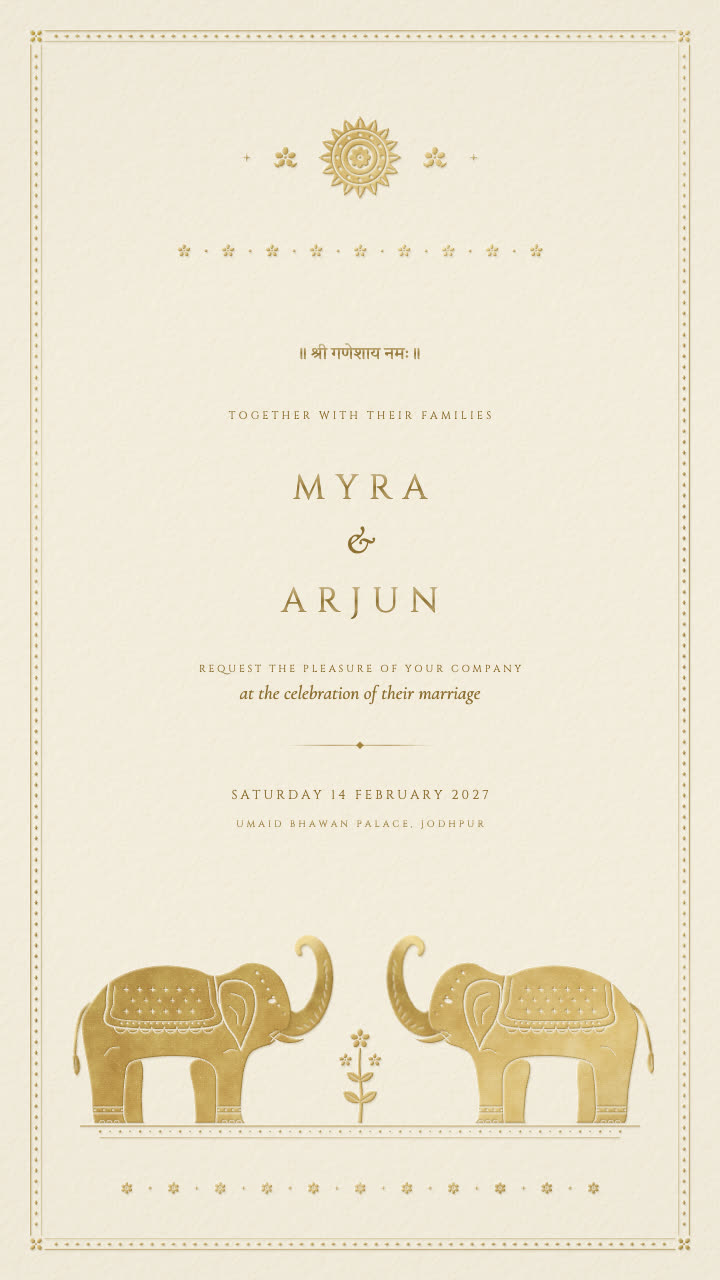
Gajraj is our gold foil block print on cream cotton paper. Two caparisoned elephants raise their trunks in greeting over a flowering shrub, under a sun medallion and rows of tiny butis. In the animated version, light slowly sweeps across the foil, so the gold glints the way real foil does when you tilt a card in your hand. It is grand without being loud, which is the balance most palace weddings are looking for.
Gold foil pairs well with cream, ivory and deep colours. It does not need much company. If you are drawn to this finish, our gold foil and vintage collections have more.
Elephants and horses: the baraat arrives
For centuries, elephants and horses have marked the arrival of a groom in India. A caparisoned elephant in a zari jhool, trunk raised. A white Marwari horse with inward-curving ears and a plumed kalgi. These are not just decorative motifs. They carry memory: the memory of a hundred baraats, the sound of shehnai and dhol, the feeling of a procession. On an invitation, they tell guests the kind of wedding this will be.
 Seen hereGhodaWedding invitation · Marwari
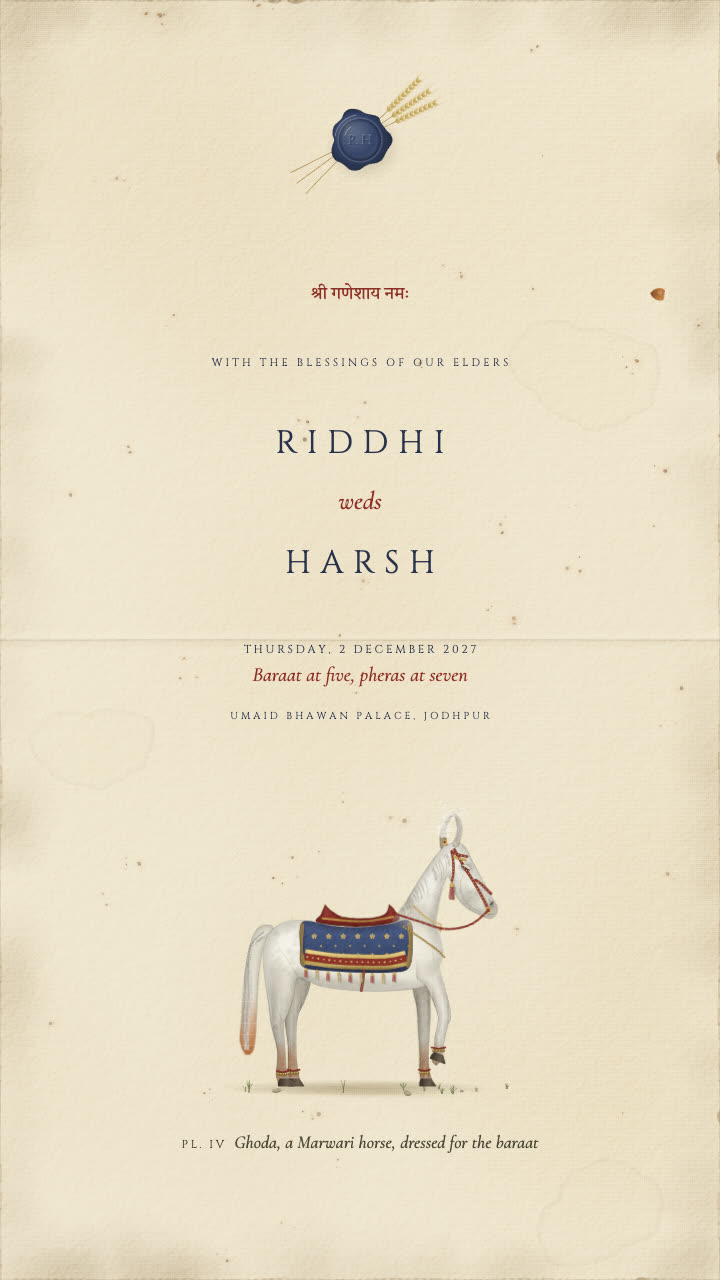
Ghoda is a white Marwari horse dressed for the baraat, with a red bridle and an indigo saddle cloth, painted like an old natural-history plate beneath an indigo wax seal. It is dignified and quiet. The style suits families who want tradition without ornament.
 Seen hereBaggiReception invitation · Marwari
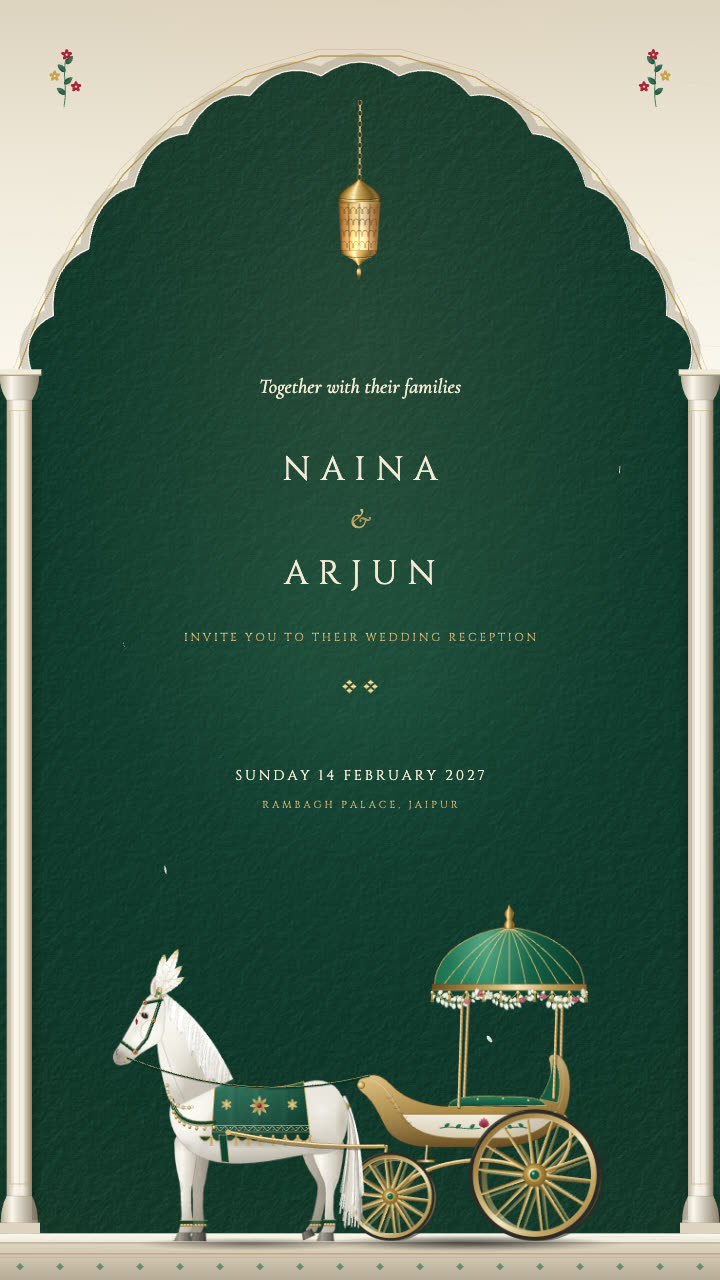
For the reception, Baggi takes the same feeling further. Under a white marble palace porch, a Marwari horse in emerald and gold waits with the wedding carriage, tossing his head so the plume on his brow flicks. Deep emerald and gold, three cards. It has the air of an arrival, which is fitting for the final celebration of the wedding.
Palace gardens and painted courtyards
A palace wedding often happens in a garden: a courtyard with a fountain, a lawn between sandstone walls, a terrace overlooking a lake. The invitation can carry that setting before the guest arrives.
 Seen hereBahaarWedding invitation
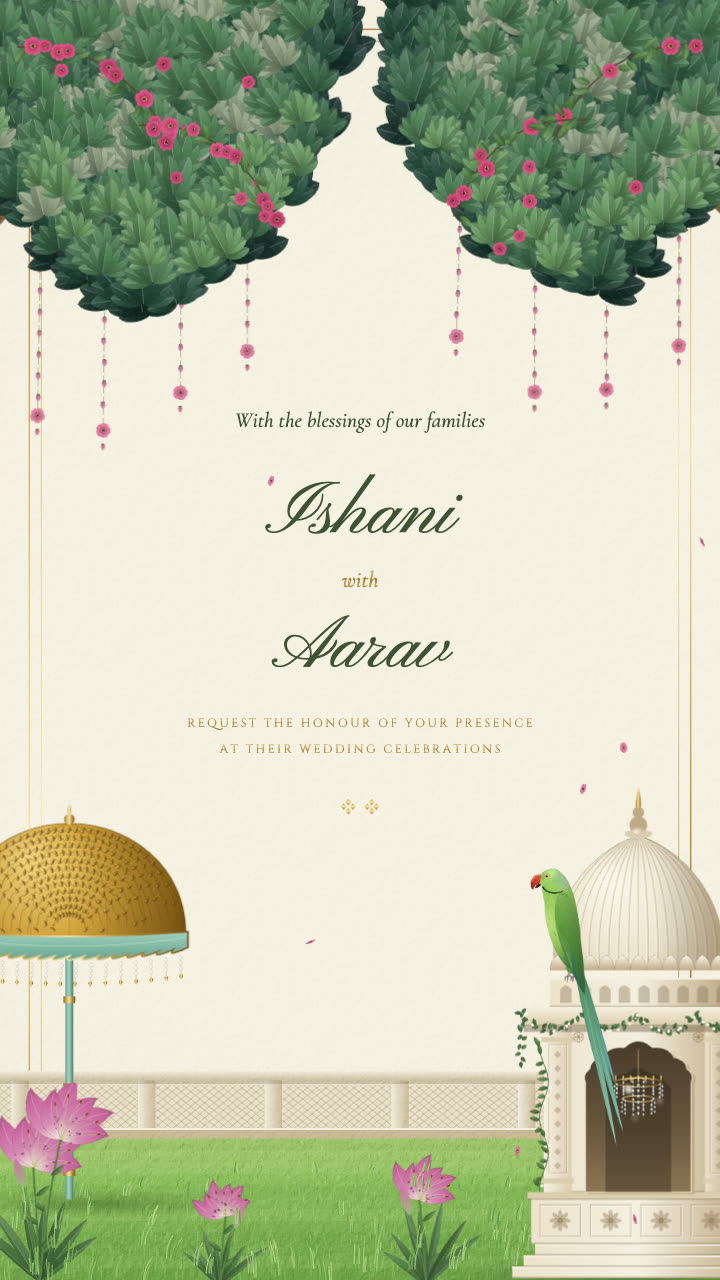
Bahaar is our painted palace garden. Flowering trees with hanging bud strings, a gold chhatra, a carved sandstone chhatri with a crystal chandelier, and a parrot keeping watch. There is a great deal of detail in it, and yet the card never feels busy. In the animated version, the bud strings sway and petals drift. It is the kind of card that rewards a second look.
For families choosing a palace in Jaipur or Udaipur, our destination wedding invitations cover designs by city. Rajwada brings the pink stone of a Jaipur haveli, and Pichola opens at dusk on Lake Pichola. Both feel palatial in their own way.
Rich colours that hold their weight
Royal palettes tend to be deep rather than bright. Burgundy, navy, emerald, plum, old gold. These are colours that photograph well, hold up against candlelight and do not fight for attention on a crowded phone screen.
A useful rule: one dominant colour, one metallic accent, and plenty of calm space. Burgundy and gold. Navy and silver. Emerald and brass. The empty paper is part of the design. It is what makes the rest feel deliberate.
If you are not sure where to start, our guide to colour palettes breaks down the most popular pairings and shows how they look in practice.
Formal wording for a formal occasion
A royal card deserves wording to match. That does not mean stiff or old fashioned. It means considered. Short lines, no extra titles, a warm but unhurried pace.
The most elegant palace invitations often begin with a blessing line in Sanskrit or Hindi, centred at the top. Below, the names of the hosts, the names of the couple, the date and venue, and a line of welcome. Nothing more. The empty space around the words is part of the grace.
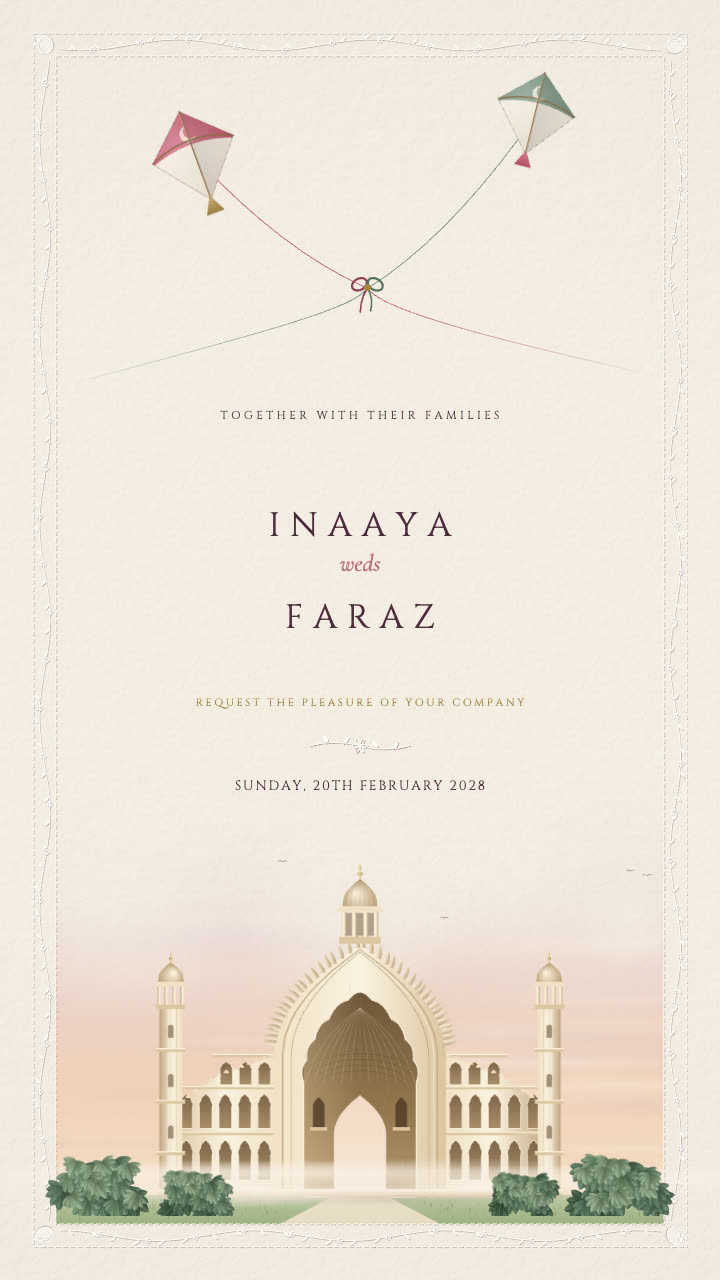 Seen hereTehzeebWedding invitation
Tehzeeb is a good example of how restraint and grandeur work together. Two kites met over Lucknow and, instead of cutting each other loose, their strings tied into a knot. Rumi Darwaza glows below, framed in white-on-white chikankari. It is playful and regal at once, and the text sits in the generous space the design leaves for it.
If you would like to see sample lines in Hindi and English, our wording guide has templates you can use as a starting point.
Matching the grandeur across events
A palace wedding is rarely just one evening. There is often a haldi in a courtyard, a mehendi on a terrace, a sangeet in a ballroom, a reception under chandeliers. Each event has its own mood, and the invitations can reflect that while still feeling like one suite.
The simplest approach is to choose a main design for the wedding card, then pair it with event cards in the same palette. A gold foil wedding invitation might be followed by a sangeet card in deep plum and gold, and a reception card in cream and brass. The thread is colour and finish, not motif.
We can help you plan this. When you write to us on WhatsApp, let us know the full list of events and we will suggest which designs sit well together.
How to order
Choose a design from our collection, or describe the feeling you are after, and write to us on WhatsApp with your names, dates and venues. We personalise every card in our studio and send a proof within 48 hours. Two rounds of changes are included. Every card is 1080 by 1920, sized for WhatsApp and Instagram.
A personalised still invitation is ₹5,000. The same design gently animated, delivered as a video, is ₹10,000. If you have a vision for something entirely new, perhaps a painting of your own palace venue or a family crest, a custom commission drawn from a blank page is ₹15,000. We accept only a few of these each month.
Next storySecond Marriage Wedding Invitations: Wording for a New Beginning
Explore the collection of luxury wedding invitations, or write to us on WhatsApp.