Wedding Invitation Wording in Hindi and English: Samples
Sample wedding invitation wording in Hindi and English for parents, grandparents and couples hosting, with traditional blessing lines and etiquette notes.
An invitation is read before it is admired. Guests may linger over the illustration, but the words are what they return to: who is inviting them, whom they are celebrating, and where they need to be.
Getting the wording right is mostly a matter of answering three questions. Who is hosting? Which language, or languages, will the family use? And would you like a blessing line at the top? Below are sample wordings for each case, in English and in Hindi, which you are welcome to borrow and adapt. We have used the names Ishani Kapoor and Aarav Malhotra throughout; replace them with your own.
Begin with a blessing
Many Hindu families open the invitation with a line of reverence. It is a prayer or a salutation offered by the family, placed quietly at the very top of the card in small type. A few of the most loved:
॥ श्री गणेशाय नमः ॥
Shri Ganeshaya Namah, salutations to Shri Ganesh, who is invoked at the start of every auspicious undertaking. It is the most common opening line on Hindu wedding cards across North and West India.
वक्रतुण्ड महाकाय सूर्यकोटि समप्रभ। निर्विघ्नं कुरु मे देव सर्वकार्येषु सर्वदा॥
A well known shloka to Shri Ganesh, a prayer that every undertaking may be free of obstacles. It suits a formal card with space for two lines.
मंगलम् भगवान विष्णुः मंगलम् गरुड़ध्वजः। मंगलम् पुण्डरीकाक्षः मंगलाय तनो हरिः॥
A shloka seeking auspiciousness from Bhagwan Vishnu, often chosen by Vaishnav families.
In English, families who prefer a simpler opening often write Seeking the blessings of Shri Ganesh, or simply With the blessings of our elders.
One gentle note on tone. The blessing line should always be the family's own prayer, offered upward. It is best to avoid wording that speaks on behalf of a deity, such as a line claiming that a god invites the guests or wishes something for them. The family invites; the family prays for blessings. That keeps the card both respectful and accurate.
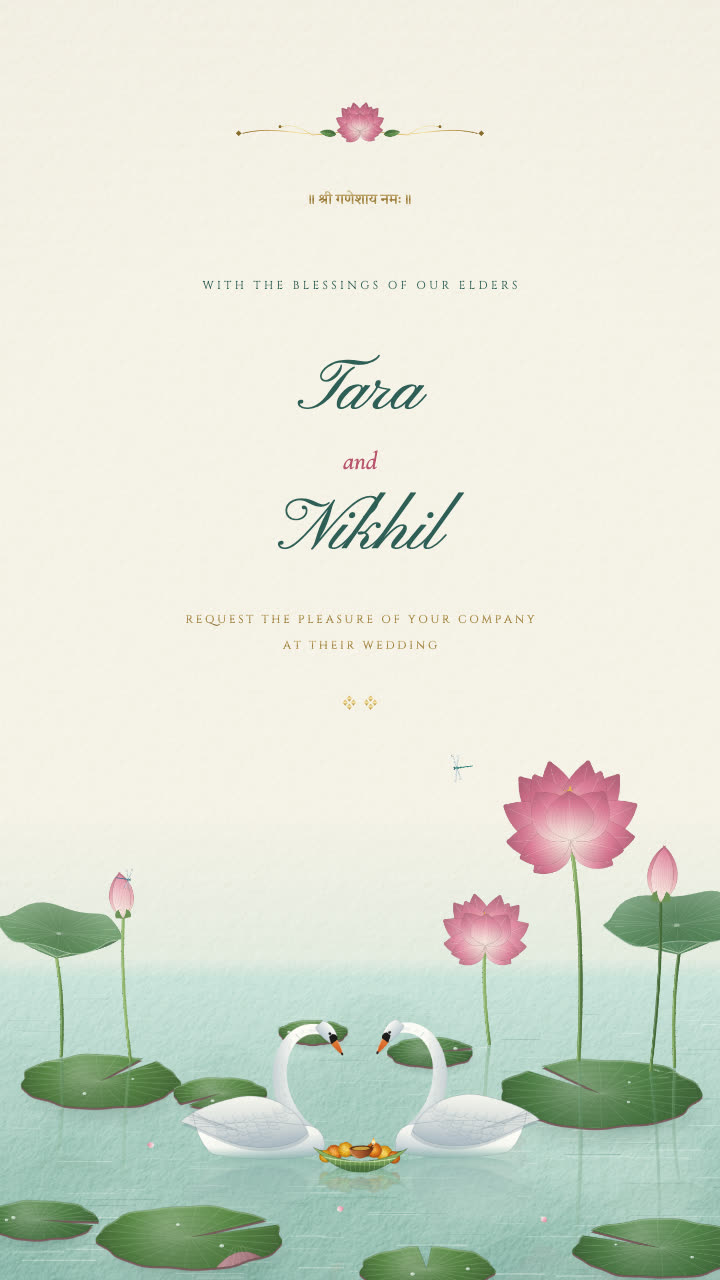 Seen hereKamalWedding invitation
Kamal carries ॥ श्री गणेशाय नमः ॥ in fine gold above a jade lotus pond, which shows how a blessing line can sit lightly at the top of a card without crowding the names below.
When the parents are hosting
This is the most traditional form, and still the most common for Indian weddings. The bride's parents traditionally send one card and the groom's parents another, each naming their own child first.
English, from the bride's parents
Sunita and Rajendra Kapoor request the honour of your presence at the wedding of their daughter Ishani with Aarav, son of Anjali and Vikram Malhotra.
A slightly warmer version:
With joy and the blessings of our elders, Sunita and Rajendra Kapoor invite you to celebrate the wedding of their daughter Ishani with Aarav, son of Anjali and Vikram Malhotra.
Hindi, from the bride's parents
श्रीमती सुनीता एवं श्री राजेन्द्र कपूर अपनी सुपुत्री सौ. कां. इशानी का शुभ विवाह चि. आरव (सुपुत्र श्रीमती अंजलि एवं श्री विक्रम मल्होत्रा) के साथ होना निश्चित हुआ है। इस मंगल अवसर पर आप सपरिवार सादर आमंत्रित हैं।
Hindi, from the groom's parents
श्रीमती अंजलि एवं श्री विक्रम मल्होत्रा अपने सुपुत्र चि. आरव के शुभ विवाह के मंगल अवसर पर, सौ. कां. इशानी (सुपुत्री श्रीमती सुनीता एवं श्री राजेन्द्र कपूर) के साथ, आपको सपरिवार सादर आमंत्रित करते हैं।
A short guide to the honorifics, since they are easy to get wrong:
- चि. (चिरंजीव) is used before the groom's name, a wish for a long life.
- सौ. कां. (सौभाग्यकांक्षिणी) is used before the bride's name, meaning one who seeks a blessed married life.
- श्रीमती and श्री are used for the parents. Write them for each parent separately, as above.
- सपरिवार means "with your family", and tells guests the invitation includes their household.
When grandparents or late elders are honoured
Many families name grandparents at the top of the card, including those who are no longer with them. In Hindi, स्व. (स्वर्गीय) is placed before the name of a late elder.
With the blessings of Smt. Kamla Devi and the late Shri Mohanlal Kapoor
आशीर्वाद: श्रीमती कमला देवी एवं स्व. श्री मोहनलाल कपूर
If you would rather not list several generations on the main card, a single line works just as well: In loving memory of our grandparents, whose blessings are with us.
When the couple is hosting
More couples now host their own weddings, especially smaller or destination celebrations. The wording becomes simpler and more personal.
English
Together with their families, Ishani Kapoor and Aarav Malhotra invite you to celebrate their wedding.
Ishani and Aarav are getting married, and it would not be the same without you.
Hindi
अपने परिवारों के आशीर्वाद के साथ, इशानी और आरव आपको अपने विवाह समारोह में सादर आमंत्रित करते हैं।
When both families invite together
For a joint card, name the families rather than every individual.
The Kapoor and Malhotra families joyfully invite you to the wedding of Ishani and Aarav.
कपूर एवं मल्होत्रा परिवार, इशानी एवं आरव के शुभ विवाह के पावन अवसर पर, आपको सपरिवार सादर आमंत्रित करते हैं।
The closing lines families love
Hindi wedding cards traditionally end with a few warm lines from the extended family. They are optional, but they carry real affection, and they translate beautifully to a closing card.
- दर्शनाभिलाषी, "eager to see you", followed by the names of uncles, aunts and cousins.
- स्वागतोत्सुक, "eager to welcome you", often used by the hosts.
- बाल मनुहार, the children's plea, a sweet line in the voice of the youngest family members: मेरे भैया की शादी में ज़रूर-ज़रूर आना।
- आपका आशीर्वाद ही हमारा उपहार है, "your blessings are our gift", for families who would prefer guests not bring presents.
Event names in Hindi
If your events card is in Hindi, these are the usual terms:
- सगाई for the engagement, and तिलक or रोका where the family holds one
- हल्दी and मेहंदी for the haldi and mehendi
- संगीत संध्या for the sangeet evening
- बारात प्रस्थान for the departure of the baraat
- पाणिग्रहण संस्कार or फेरे for the wedding ceremony itself
- प्रीतिभोज or आशीर्वाद समारोह for the reception
For ideas and wording for the smaller events, see our note on haldi, mehendi and sangeet invitations.
Wording for other traditions
Every community has its own opening, and it is worth asking the eldest person in the family which one they would like.
- Telugu invitations often open with శ్రీరస్తు శుభమస్తు అవిఘ్నమస్తు (Srirastu Subhamastu Avighnamastu), a wish for prosperity, auspiciousness and freedom from obstacles. See our Telugu designs.
- Bengali invitations commonly carry প্রজাপতয়ে নমঃ (Prajapataye Namah) at the top, with শুভ বিবাহ (Shubho Bibaho) as the heading. See our Bengali designs.
- Tamil invitations often begin with the small pillaiyar suzhi, உ, or a line to the family deity. See our Tamil designs.
- Sikh families often open an Anand Karaj invitation with ੴ ਸਤਿਗੁਰ ਪ੍ਰਸਾਦਿ (Ik Onkar Satgur Prasad).
 Seen hereTalambraluWedding invitation · Telugu
Talambralu was drawn for a Telugu wedding: a mango-leaf thoranam stirring in the breeze, two sparrows showering talambralu over each other, and a purna kumbham crowned with a coconut.
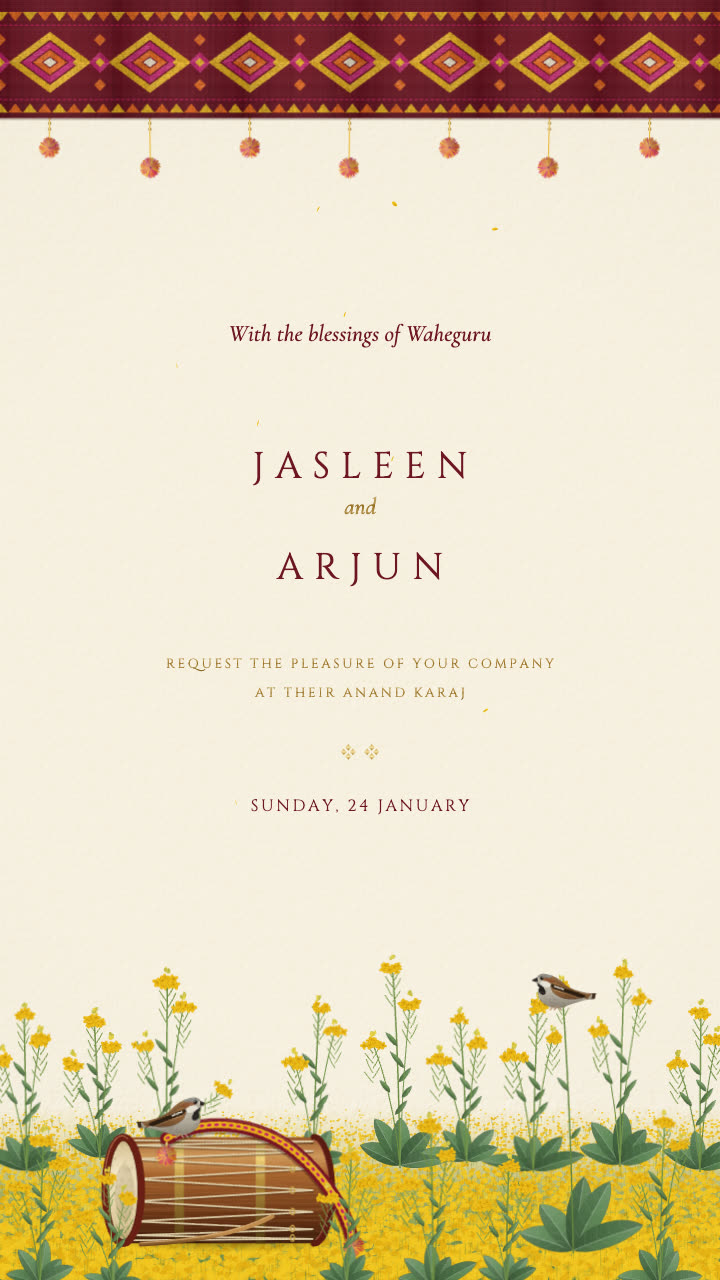 Seen herePhulkariWedding invitation · Punjabi
For a Punjabi wedding, Phulkari frames the words in a hand-stitched phulkari border with silk tassels, above a sarson field where the baraat dhol rests. Browse more in our Punjabi and Marwari collections, or every wedding invitation we make.
A few last checks
- Spell every name the way the family spells it, in both scripts. Ask, even if you think you know.
- Use titles consistently. If one parent is Dr., check whether the other set of parents would like their titles too.
- Keep the two languages on separate cards or separate blocks, rather than alternating line by line.
- Read it aloud to an elder. If it sounds right to them, it is right.
When you order a Taarikh invitation, share your wording on WhatsApp in English, Hindi or both, and we will set it with care, Devanagari included. You will see a proof within 48 hours, with two rounds of changes included. A still card is ₹5,000, an animated one ₹10,000, and an entirely new design ₹15,000.
 Next storyHaldi, Mehendi and Sangeet Invitations: Ideas and Wording
Explore the collection of luxury wedding invitations, or write to us on WhatsApp.