Gold Foil and Vintage Wedding Invitations, Drawn for the Screen
Gold foil and vintage wedding invitations in digital form: why foil feels rich, four metal and paper pairings, and how to choose painted, foil or vintage.
Ask a family what a royal wedding invitation looks like and most will describe the same thing. A thick cream card, soft at the edges. A little gold that catches the light when you tilt it. A pattern of tiny repeated flowers, pressed rather than printed. Very few words.
In this note we look at why gold foil and block print feel so rich, how that feeling carries onto a phone screen, and the vintage animal plates beside them in our collection, with a short guide to choosing at the end.
One thing first, plainly said. Our cards are digital. The foil you see on them is foil drawn in our studio, with its shine and shadow rendered in code. It is not physical metal, and we do not print or stamp paper. What we have tried to do is understand why the real thing works, and draw that.
Why foil and block print feel luxurious
Block printing is one of the oldest crafts in India. A motif is carved into a wooden block, and the block is pressed again and again, so a small flower or leaf becomes a field of butis. Foil stamping on paper works in a similar spirit: a metal die presses a thin layer of gold or silver into the sheet. Both leave a pattern that sits slightly into the paper rather than on top of it.
Three things make a gold foil wedding invitation look elegant, and none of them is quantity.
- The paper. Good foil cards are usually made on heavy cotton paper, which has a soft, slightly uneven surface. Against that texture the metal looks brighter and the ground looks warmer.
- Restraint. A foil card rarely has more than one central motif, a border and a scatter of butis. The rest is open paper.
- One metal on one ground. Gold on cream. Silver on navy. Not gold and silver and three inks. A single metal against a single colour of paper is what makes a card read as royal rather than busy.
Four pairings of metal and paper
Each foil design in the collection is built on one pairing, and each pairing sets a slightly different mood.
Gold on cream is the classic, the one most people picture. It is warm, festive and unmistakably a wedding.
 Seen hereGajrajWedding invitation
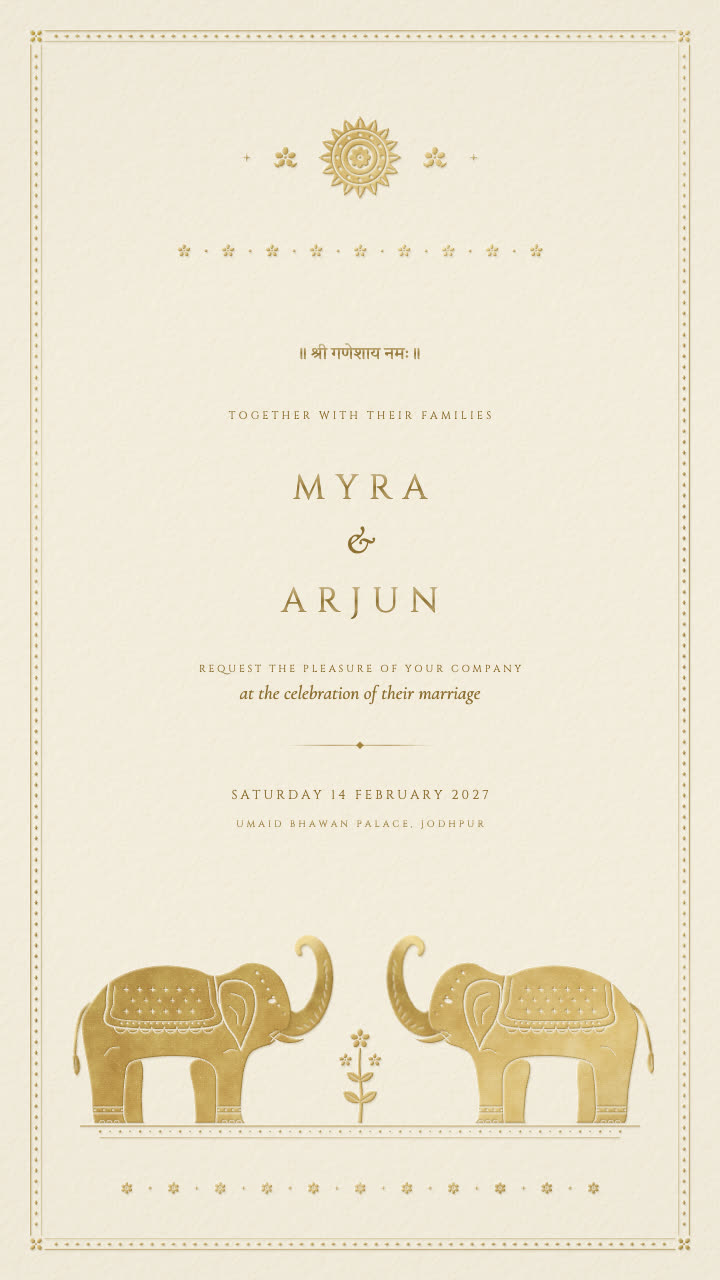
Gajraj is gold foil block print on cream cotton paper. Two caparisoned elephants raise their trunks in greeting over a flowering shrub, under a sun medallion and rows of tiny butis. In the animated version, light slowly sweeps across the foil. Kalash uses the same gold on cream for a more ceremonial card: a mango-leaf toran, a coconut-crowned kalash between two tall samai lamps, and rows of marigold butis.
Antique gold on ivory is quieter. The metal is a little deeper and the paper a little paler, so the whole card feels older and softer. Amrai, our save the date in this pairing, shows a chital stag and doe stretching up for the same mango under a little mango tree, beneath a keri pair and rows of tiny leaf butis.
Rose gold on blush is the most tender of the four, and it suits an engagement or a smaller, more personal celebration.
 Seen hereKamal TaalEngagement invitation
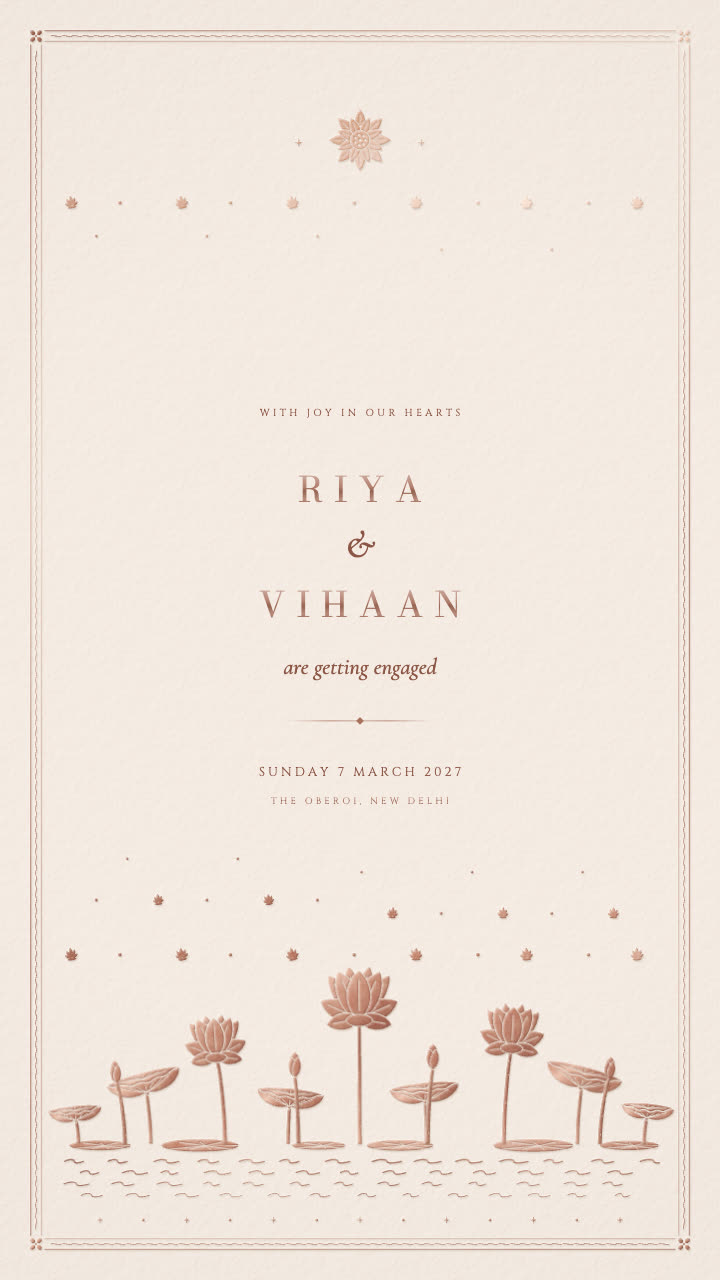
Kamal Taal is rose gold foil block print on blush cotton paper: a lotus pond along the foot of the card, tiny lotus butis scattered around a calm centre and a lotus rosette above. In motion the lotuses sway and light glides across the foil. The open centre is deliberate. It is where your names sit, with room around them.
Silver on navy belongs to the evening. It is the pairing we reach for when an event happens after dark.
 Seen hereChandiReception invitation
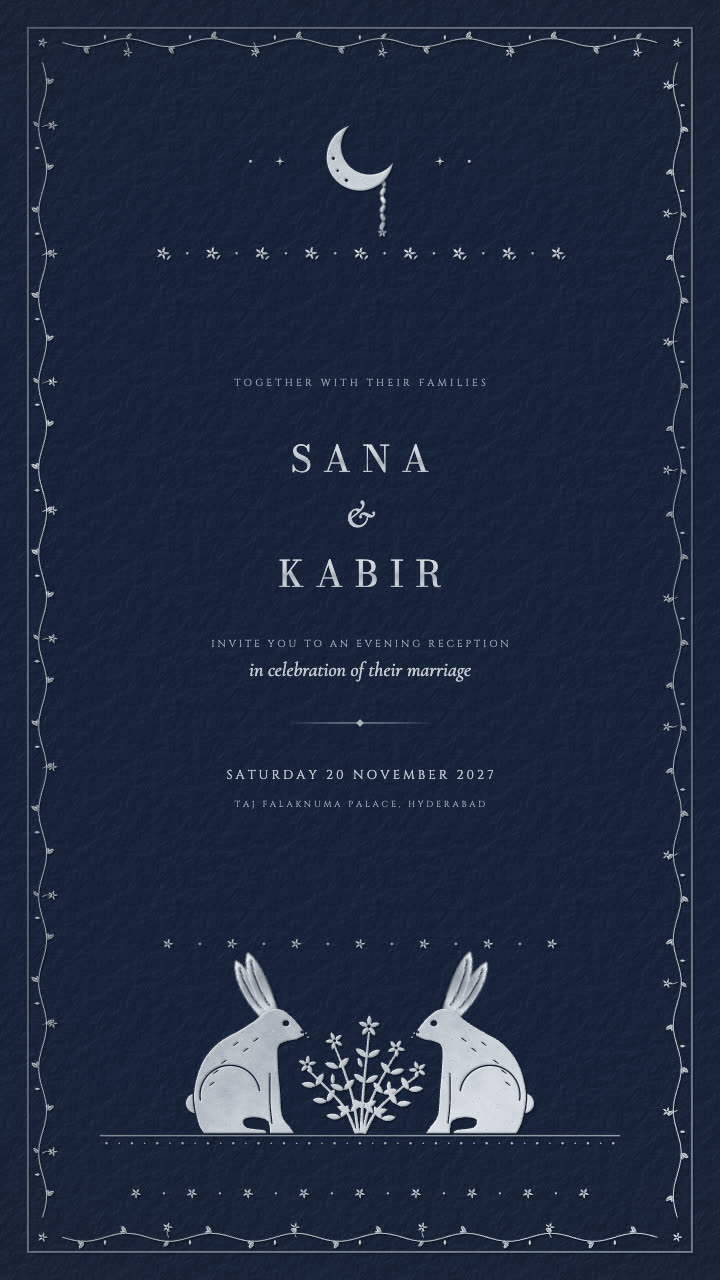
Chandi is silver foil on deep navy, made for a reception: a jasmine vine border, a crescent moon trailing a string of jasmine buds, and two hares face to face beside a flowering jasmine bush. In the animated card, moonlight sweeps the silver. It sits naturally after a gold wedding card, a change of metal that tells guests the night has begun.
How foil reads on a screen
On paper, foil comes alive when you tilt the card. The light moves and the metal answers. A phone screen cannot be tilted into new light, so a flat yellow line is all most digital "gold" ever becomes.
In the still invitation, each foil motif is drawn with its own highlights and shadows, the way the metal looks in one moment of light. Zoom in and it should still read as metal pressed into cotton.
The animated invitation, delivered as a video, does what a still cannot. A band of light travels slowly across the foil, as if someone were turning the card in their hands. It is slow and gentle, closer to a glint than a sparkle. We think this is the most honest way to show foil on a screen: not by pretending the screen is paper, but by giving guests the one moment that makes foil worth having.
The vintage natural-history plates
Beside the foil designs sits a second collection. In the late eighteenth and nineteenth centuries, Indian artists painted studies of animals and plants for European patrons, in a style now called Company School. They brought the fine detail of Mughal miniature painting to the conventions of the natural-history plate: a single creature, carefully observed, set on a plain ground with a little text below.
Our vintage cards borrow that format. Each is drawn in our studio as an aged plate, with one animal painted in fine brushwork, the couple's names beneath it, and a wax seal in a colour chosen for that design.
 Seen hereSherWedding invitation
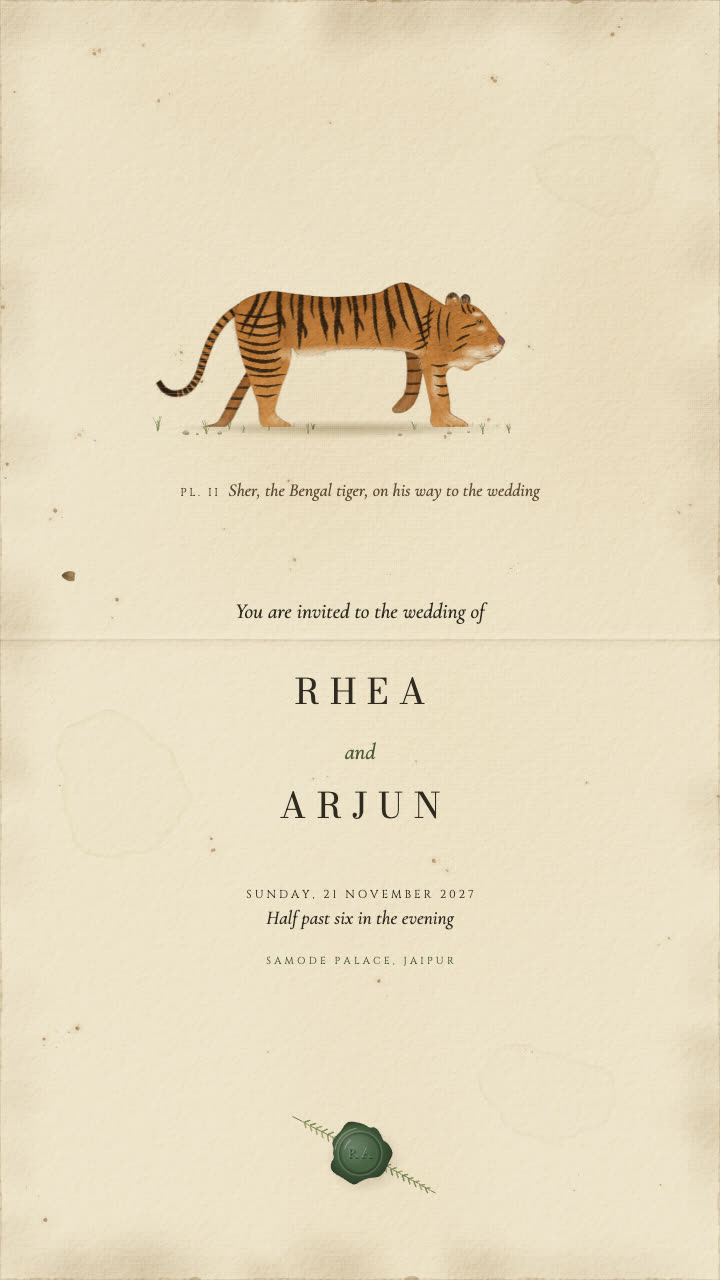
Sher shows a Bengal tiger walking across an aged natural-history plate, every stripe and hair laid in fine Company School brushwork, above the couple's names and a green wax seal with a pressed fern. It is a three card suite for the wedding, and it is the boldest card in the collection.
Which vintage plate suits which wedding
Each animal carries a slightly different meaning, so the choice often makes itself.
- Haathi, for the wedding: one Indian elephant dressed for the baraat in a madder jhool with gold borders and ankle bells, under a red wax seal. Classic and celebratory.
- Sher, for the wedding: for couples who like something unexpected, or who simply love tigers.
- Hiran, for the engagement: a spotted chital stag pausing to look back over his shoulder on an aged ivory plate, beneath a plum wax seal with a pressed rosebud. Gentle and a little romantic.
- Ghoda, for the wedding: a white Marwari horse dressed for the baraat. Made with Marwari families in mind.
- Oont, for the mehendi: a camel dressed for a desert wedding, on a sand-toned plate above a saffron wax seal. Lovely for a Jaipur celebration.
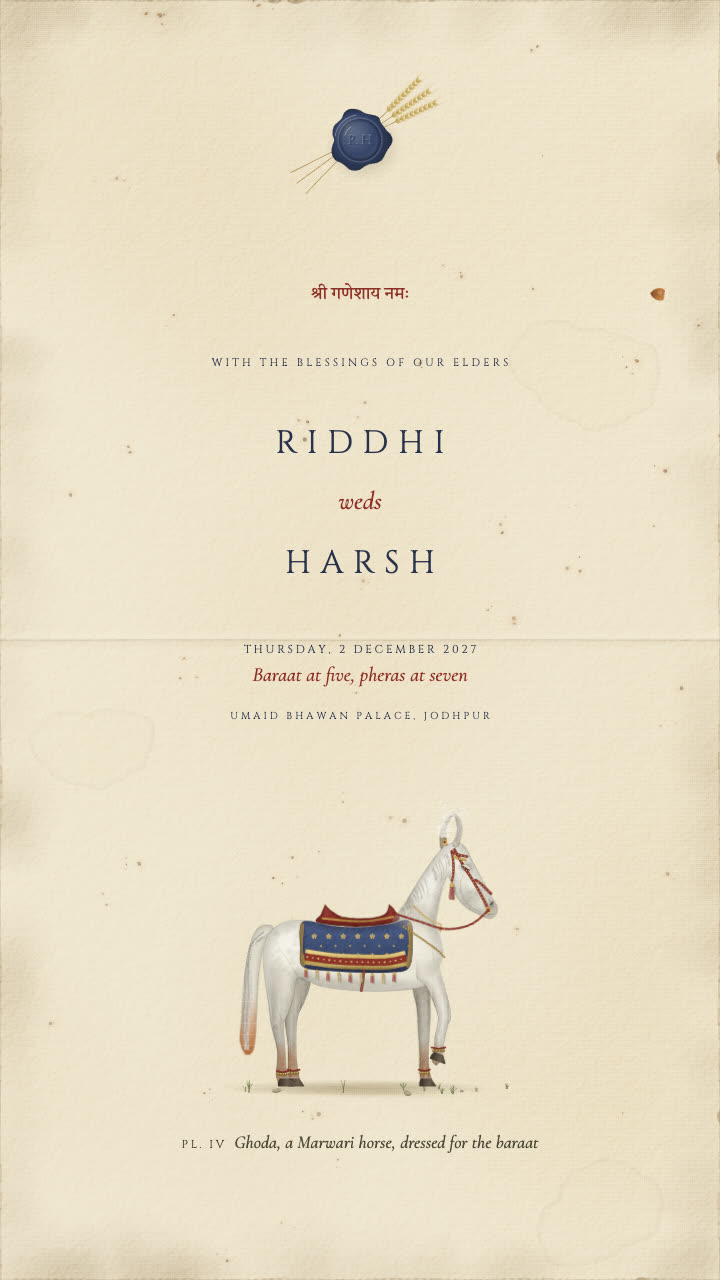 Seen hereGhodaWedding invitation · Marwari
Ghoda deserves a closer look. The white Marwari horse has the breed's inward-curving ears, a plumed kalgi, a red bridle and an indigo saddle cloth, painted like an old natural-history plate beneath an indigo wax seal. For a family whose baraat will arrive on horseback, it is a quiet nod to that moment before anyone has stepped out of the house.
Painted, foil or vintage: how to choose
Our collection falls broadly into three styles.
- Painted designs, like Bahaar with its flowering trees, gold chhatra and sandstone chhatri, are full scenes in colour. Choose painted if you want a setting, a story or a city in the card.
- Foil designs are pattern, metal and paper. Choose foil if you want the most formal, royal feeling. They also give you the clearest way to mark events apart: gold for the wedding, rose gold for the engagement, silver for the reception.
- Vintage plates are one animal, one seal and a lot of quiet. Choose vintage if you want something classic but a little unusual, or if one of the animals already means something to your family.
There is no rule against mixing. A family might send a painted save the date, a foil wedding card and a vintage plate for the mehendi. If you are planning cards for several events, our note on haldi, mehendi and sangeet invitations may help, and what makes a luxury wedding invitation explains why we lean on restraint.
Ordering a foil or vintage card
Choose a design and write to us on WhatsApp with your names, dates and venues. We personalise it and send a proof within 48 hours, with two rounds of changes included. Every card is 1080 by 1920, sized for WhatsApp and Instagram.
A personalised still invitation is ₹5,000. The animated version, where the light moves across the foil, is ₹10,000 and is delivered as a video. If you would like a new foil pattern or a different animal on a plate, drawn for your wedding alone, a custom design is ₹15,000.
 Next storyIndian Wedding Invitation Motifs and What They Mean
Explore the collection of luxury wedding invitations, or write to us on WhatsApp.