Indian Wedding Invitation Motifs and What They Mean
What the motifs on Indian wedding cards are felt to say: marigold, mango leaves, lotus, peacock, elephant, kalash, diya, fish, jasmine and the colours.
Most guests look at a wedding card for a few seconds before they read a word. In those seconds they take in a picture: a peacock, a lotus, a string of marigolds, an elephant in a gold jhool. Long before the names and the venue, the picture has told them something about the day.
Families rarely choose these pictures at random. A grandmother asks for mango leaves at the top. A mother wants the lotus. Behind each request is a feeling, usually one that has been passed down rather than written down.
This note gathers the motifs we are asked for most often and what families usually feel they say. These are broad, widely held associations, not rules. Meanings shift from region to region and from home to home, and the eldest person in your family is always the best guide.
Flowers: marigold, lotus and jasmine
Marigold
No flower says "wedding" in India quite like the marigold. It is strung into garlands, hung in torans and heaped in brass bowls. Its orange and yellow read as sunshine and celebration, and for many families it simply feels auspicious. On a card, a few marigolds tell guests at once that this is a festive occasion.
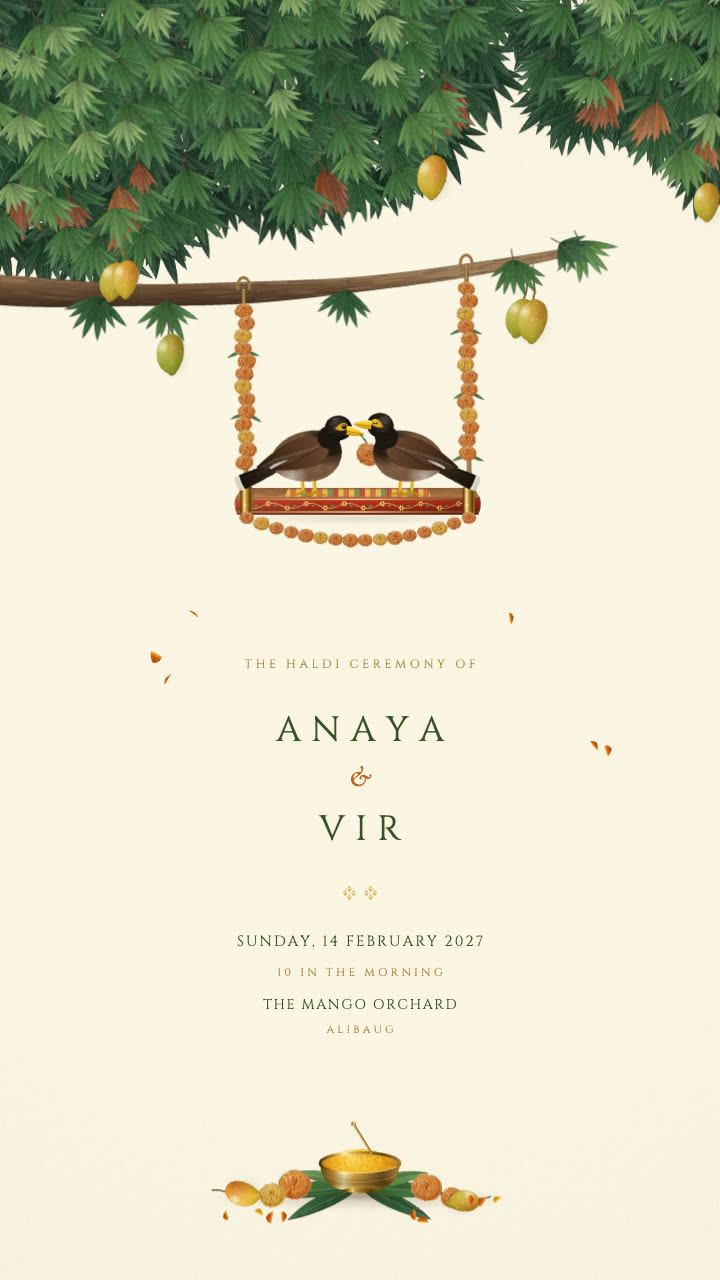 Seen hereJhoolaHaldi invitation
Jhoola is one of our gentlest uses of it. Under a mango tree heavy with ripening fruit, two mynas share a marigold on a little lacquered jhoola whose ropes are wound with marigolds, swinging in the breeze. It is a haldi card in three parts (invitation, details and a sweet goodbye), and the marigold does most of the talking.
Lotus
The lotus rises clean and open from muddy water, so it is widely read as a sign of purity and grace, and many families also link it with Lakshmi and good fortune. It suits a card that wants to feel calm rather than loud. Kamal builds a jade pond of painted lotuses, buds and lily pads, while Kamal Taal sets a lotus pond in rose gold foil on blush cotton paper.
Jasmine
Jasmine is the scent of many weddings, worn in the hair and strung into gajras. Families tend to associate it with sweetness and freshness. Because it is small and white, it works best as a quiet detail. In Mogra, a little palm squirrel hauls up one more jasmine gajra to hang beside the rest, and Chandi runs a jasmine vine around silver foil on deep navy.
Mango leaves, the kalash and the diya
These three often travel together, because they so often appear together at the doorway or the mandap.
A toran of mango leaves over a door is one of the most familiar signs that a home is celebrating. Families usually see it as a welcome and a wish for good fortune. The mango itself carries a sense of plenty and sweetness, and its shape, the keri many people know as paisley, turns up in textiles everywhere.
The kalash, a pot crowned with a coconut and mango leaves, is widely felt to stand for fullness and abundance. The diya is light: a blessing, a welcome, and the simple wish that the path ahead is bright.
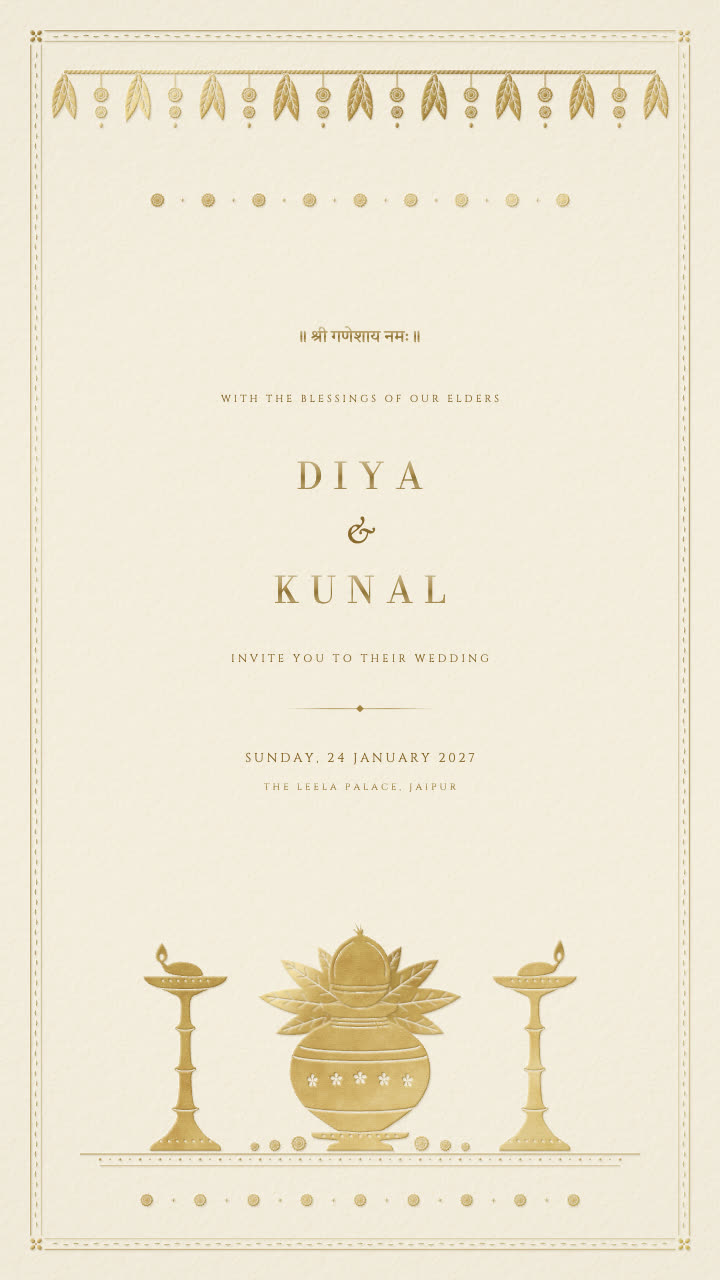 Seen hereKalashWedding invitation · Marwari
Kalash puts all of this on one card: a gold foil block print on cream cotton paper, with a mango-leaf toran across the top and a coconut-crowned kalash between two tall samai lamps, above rows of marigold butis. In the animated version, light sweeps the foil and the flames flicker. It has three cards.
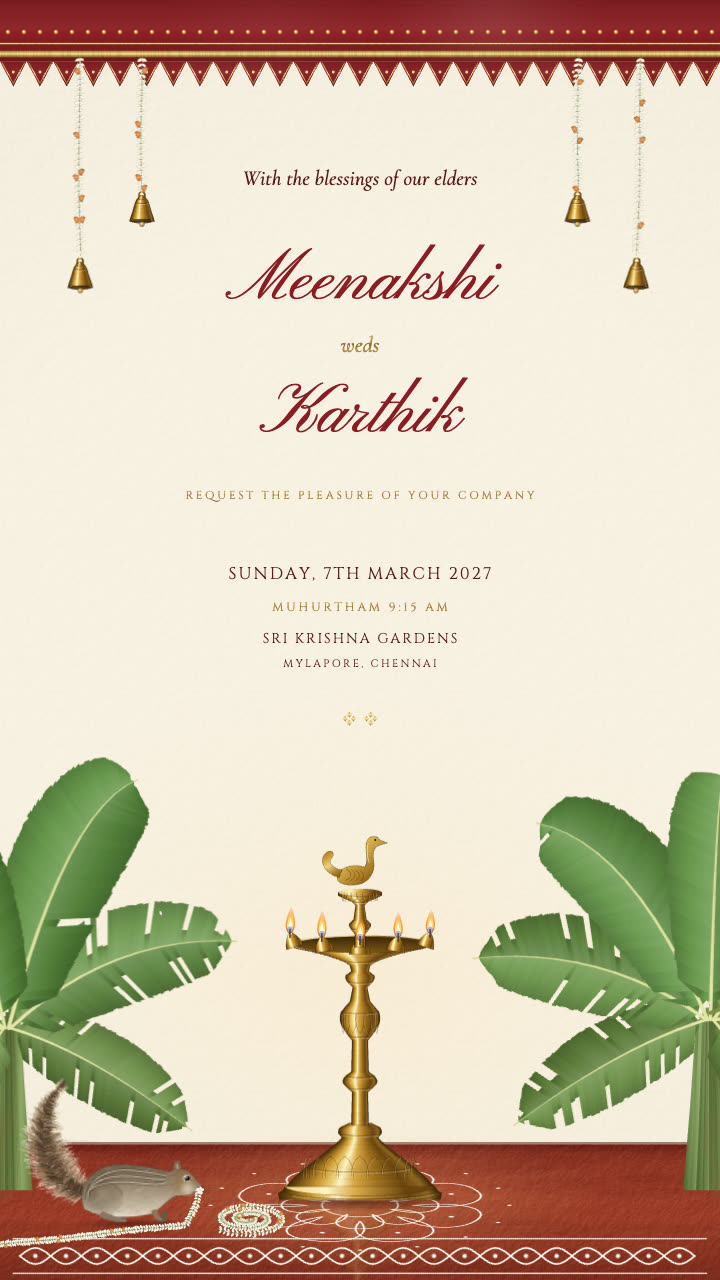 Seen hereDeepamWedding invitation · Tamil
For a lamp in another setting, Deepam has a Kanjivaram-red veil lifting on a lit brass kuthuvilakku, a rice-flour kolam on a red-oxide floor and banana plants at the threshold, while a little palm squirrel drags a string of jasmine to the lamp. It is drawn for a Tamil wedding, with three cards: invitation, events and thank you.
Peacocks, parrots and birds in pairs
Peacock
The peacock is India's national bird, and it carries a great deal of feeling: beauty, grace, romance and the joy of the first rain. A peacock wedding invitation tends to feel both regal and warm.
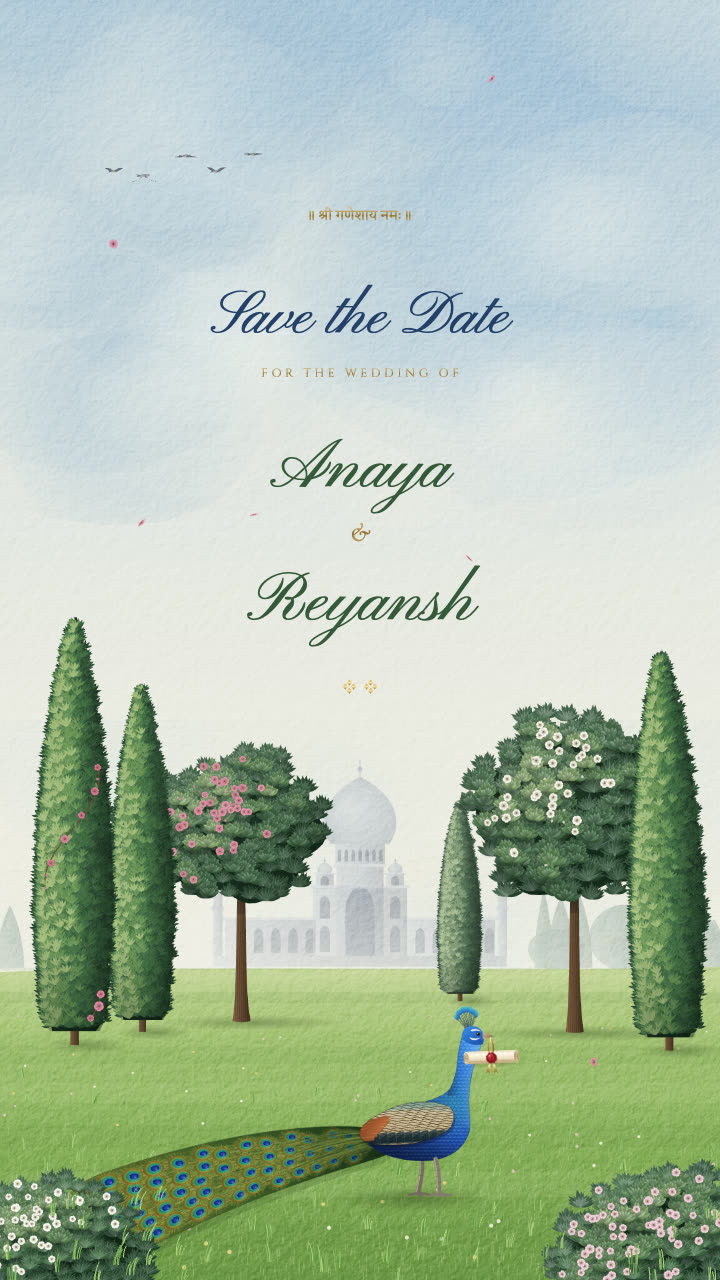 Seen hereBaghSave the Date invitation
Bagh is our peacock save the date. A peacock crosses a Mughal garden carrying a sealed invitation scroll in its beak, under a watercolour sky with cypresses, blossoming trees and a distant palace, and the camera rises from the peacock to reveal the card. It has two cards: the save the date, then the date, city and hosts. Peacocks also appear in the woven pallu of Paithani and dancing garba in Bandhani.
Parrots and pairs of birds
Parrots turn up again and again in Indian miniature painting and folk art, often close to lovers, and many families read them as messengers of love. More broadly, any pair of birds says companionship: two creatures sharing one branch, one task, one flower. It is the simplest way to show a couple without drawing the couple.
In Tota, two parakeets thread a marigold garland together. In Dilli, two green parakeets drape a garland across the dome of Humayun's Tomb. In Koyal, a koel offers his mate a ripe mango with a tiny gold ring slipped round the stalk.
Elephants and fish
Elephant
The elephant brings strength, dignity and good fortune, and a sense of grand procession that belongs to the baraat. For many families it is also a gentle nod to Ganesha. An elephant wedding invitation feels celebratory and steady at once.
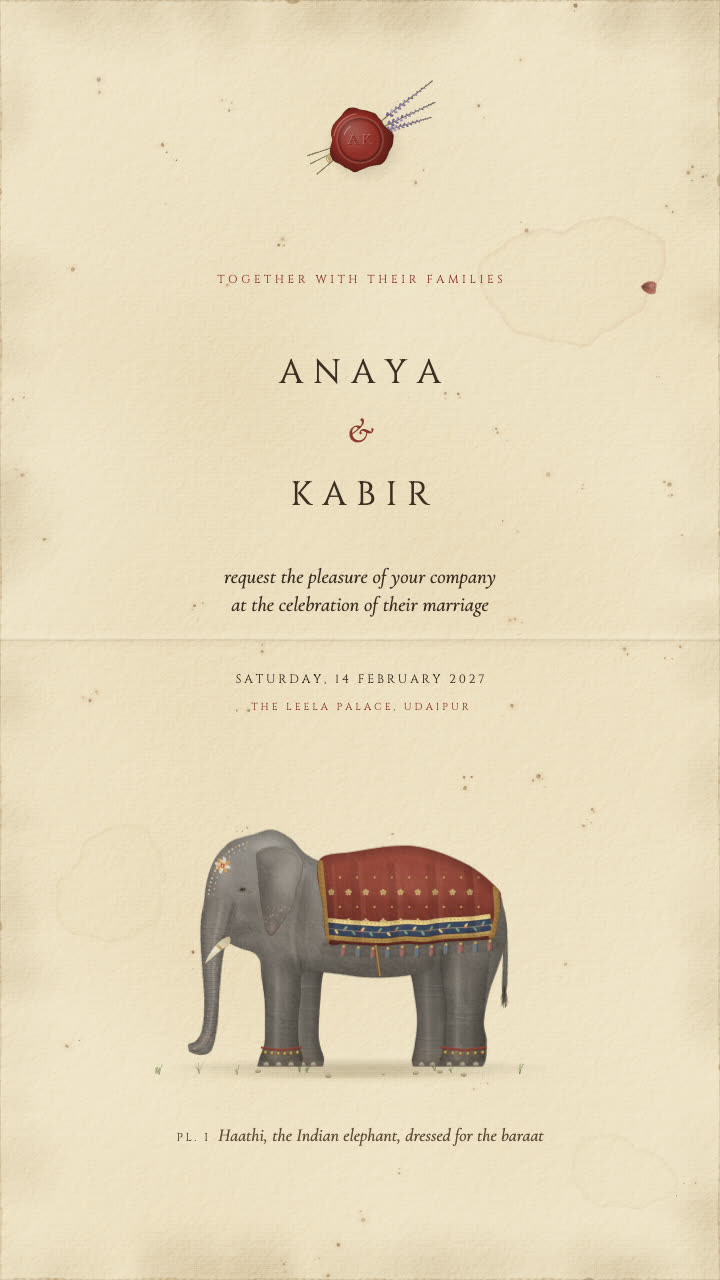 Seen hereHaathiWedding invitation
Haathi is drawn like an aged natural-history plate: one Indian elephant dressed for the baraat in a madder jhool with gold borders and ankle bells, in fine Company School brushwork under a red wax seal. It has three cards. For a brighter elephant, Gajraj has two caparisoned elephants raising their trunks in greeting in gold foil.
Fish
Fish are most closely tied to Bengali weddings, where many families see them as a sign of plenty and good luck. Alpona dresses two rui fish as bride and groom, exchanging a rajanigandha mala inside red laal paar borders.
What the colours say: red, yellow, green and gold
Colour speaks before any motif does, so it is worth choosing deliberately.
- Red is the colour most families link with marriage itself: the bride, celebration and commitment.
- Yellow belongs to haldi and turmeric. It feels bright and full of beginnings.
- Green is new growth: mango leaves, banana plants, henna. It sits naturally on a mehendi card.
- Gold is prosperity and festivity. It works best as an accent, a border or a foil, rather than covering the whole card.
Most good palettes lead with one of these and let a second support it. Red with gold is the classic. Yellow with green feels like a morning haldi. Ivory with gold is quieter, and lets a single coloured motif stand out.
Choose one strong motif
Once families learn what each symbol means, the natural impulse is to include all of them: a lotus, an elephant, a peacock, a kalash, mango leaves, diyas, a pair of parrots, and marigolds in every gap.
We gently talk families out of it. A card with ten meanings ends up saying none of them clearly. The eye has nowhere to rest, and the names get lost.
Pick the one picture your family would recognise first, and let it speak for the rest.
A few questions help:
- Which motif does the eldest person at home ask for? That is often the answer.
- Which one fits the event? Marigold and mango for a haldi, a pair of birds for an engagement, an elephant or a kalash for the wedding.
- Can the others become small details? A toran along the top or a scatter of butis can hold a second idea without crowding the first.
We wrote more about why fewer, finer elements look richer in our note on what makes a luxury wedding invitation.
Ordering a card with the motif you love
Choose a design from our wedding collection, or any other, and write to us on WhatsApp with your names, dates and venues. Every card is illustrated in our studio and sized 1080 by 1920 for WhatsApp and Instagram. You will see a proof within 48 hours, and two rounds of changes are included.
A still invitation is ₹5,000. The same design animated and delivered as a video is ₹10,000. If the motif your family loves is not in the collection, we can draw an entirely new design around it for ₹15,000, with a proof and two rounds of changes included. We accept only a few of these each month.
 Next storySave the Date Ideas for Indian Weddings: When, What and How
Explore the collection of luxury wedding invitations, or write to us on WhatsApp.