Wedding Invitations by Community: Ideas from Ten Indian Traditions
Wedding invitation ideas for Marwari, Punjabi, Bengali, Tamil, Gujarati, Malayali and other families, built on each tradition's textiles, motifs and colours.
Ask a Bengali grandmother what a wedding looks like and she may describe a red border on white cloth. Ask a Malayali one and she may describe ivory and gold. Ask a Punjabi one and she may describe a field of mustard. Every family carries a picture of its own wedding, and the best invitations borrow from that picture rather than from a general idea of "Indian".
This note walks through ten traditions we draw for, and the textiles, rituals, motifs and colours that can carry an invitation for each. It is not a rulebook. Families within one community do things differently, and the eldest person at home is always the best guide.
Choosing what to borrow from a tradition
There are three places a card can find its character.
- A textile. Phulkari, bandhani, kasavu, paithani and ajrak are instantly recognised, and a border is the easiest place for them to live.
- A ritual. Talambralu, a mala exchange, a lamp lit at the threshold. A small scene from the ceremony tells guests what kind of wedding they are coming to.
- A landscape. A lake, a river, a city skyline. This works well when the place matters as much as the people.
Most of our community designs use one of these, sometimes two. Very rarely all three, and for good reason, which we come to at the end.
Punjabi and Marwari wedding invitations
Punjabi
Phulkari, which means "flower work", is the embroidery many Punjabi families keep for weddings, often on a shawl or dupatta passed down through the women of the house. Its geometric stitches and warm colours make a beautiful frame. Our Phulkari design uses a hand-stitched phulkari border with silk tassels, above a sarson field where the baraat dhol rests while two sparrows share a sprig of mustard flowers. For a Delhi wedding, Dilli has two green parakeets draping a marigold garland across the marble dome of Humayun's Tomb. More are in our Punjabi collection, including mehendi cards such as Bulbul.
Marwari
Marwari invitations tend to lean on architecture and ceremony: havelis, jharokhas, marigold torans and the baraat itself. Rajwada opens on a pink Jaipur haveli jharokha strung with marigolds, where a pigeon flies in carrying your rolled invitation to its mate on the ledge. Ghoda is quieter: a white Marwari horse dressed for the baraat, with inward-curving ears and a plumed kalgi, painted like an old natural-history plate. For something more devotional, there is Kalash, a gold foil block print with a coconut-crowned kalash between two tall samai lamps. Browse the full Marwari collection.
Bengali and Kashmiri wedding invitations
Bengali
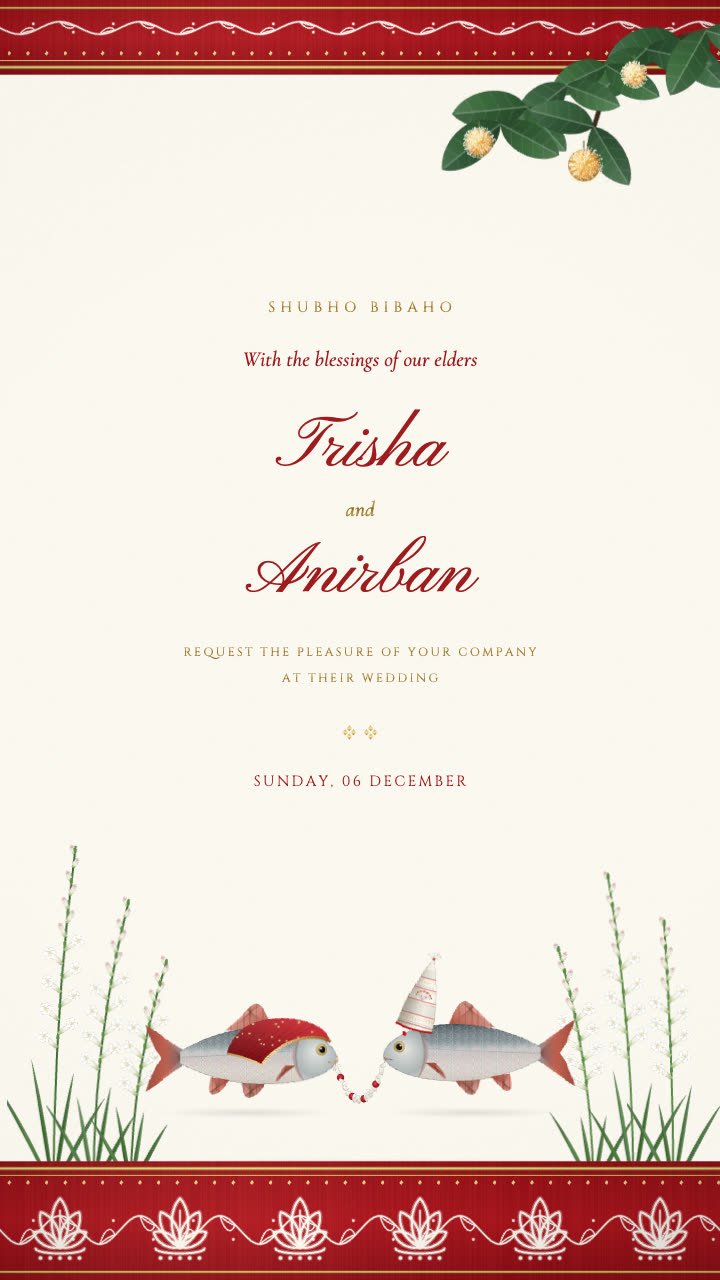
Few colour pairings say "wedding" as clearly as red and white for a Bengali family. The laal paar, a white sari with a red border, and alpona, the white floor patterns drawn by hand, are both instantly familiar.
 Seen hereAlponaWedding invitation · Bengali
Alpona brings them together: red laal paar borders painted with white alpona, and two rui fish dressed as bride and groom, one in a red veil and one in a tiny shola topor, exchanging a rajanigandha mala. It is gently playful, and for many Bengali families the fish land at once. For a Kolkata wedding, Kolkata opens a sealed envelope on a monsoon afternoon at the Maidan, where a tram strung with rajanigandha waits by the Victoria Memorial with a groom's topor on its roof. See our Bengali designs.
Kashmiri
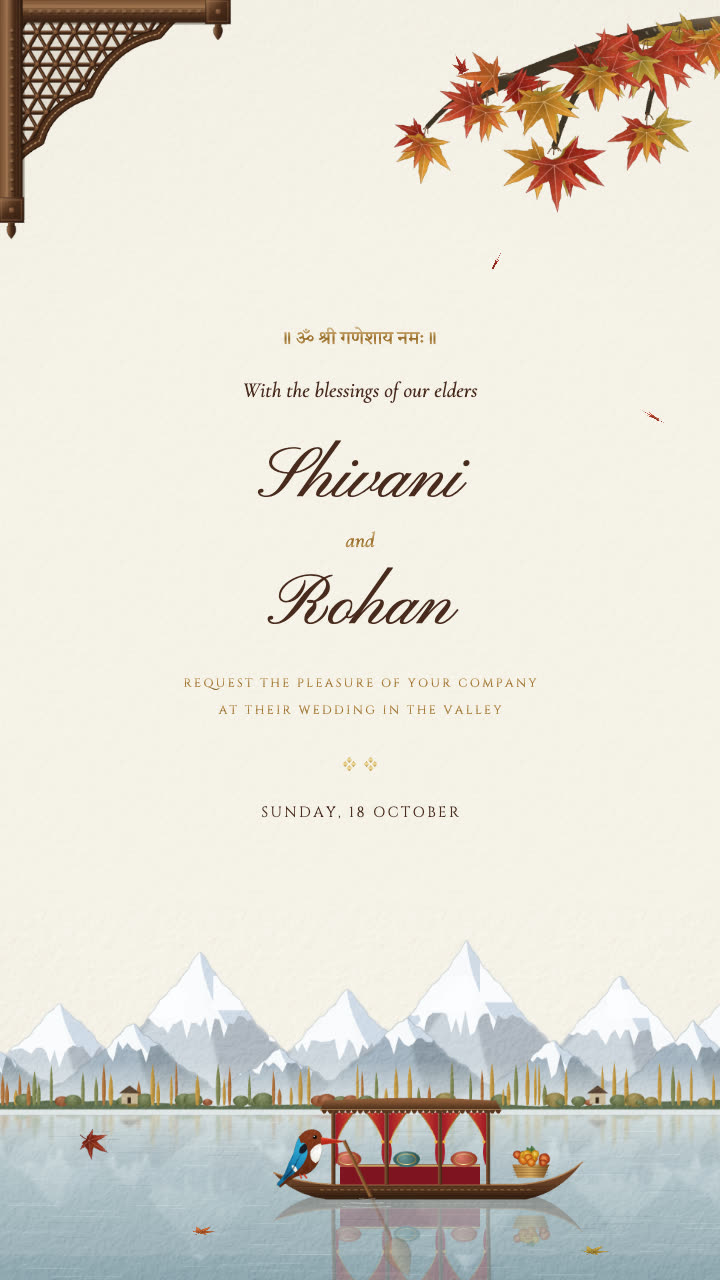
For Kashmiri families, the landscape often speaks first: chinar trees, carved walnut wood, the still water of the Dal.
 Seen hereChinarWedding invitation · Kashmiri
Chinar has chinar leaves drifting past a carved walnut window, snow mountains over the Dal, and a kingfisher rowing a shikara full of wedding flowers. The window gives the words a natural frame. More in our Kashmiri collection.
Gujarati, Maharashtrian and Sindhi wedding invitations
Gujarati
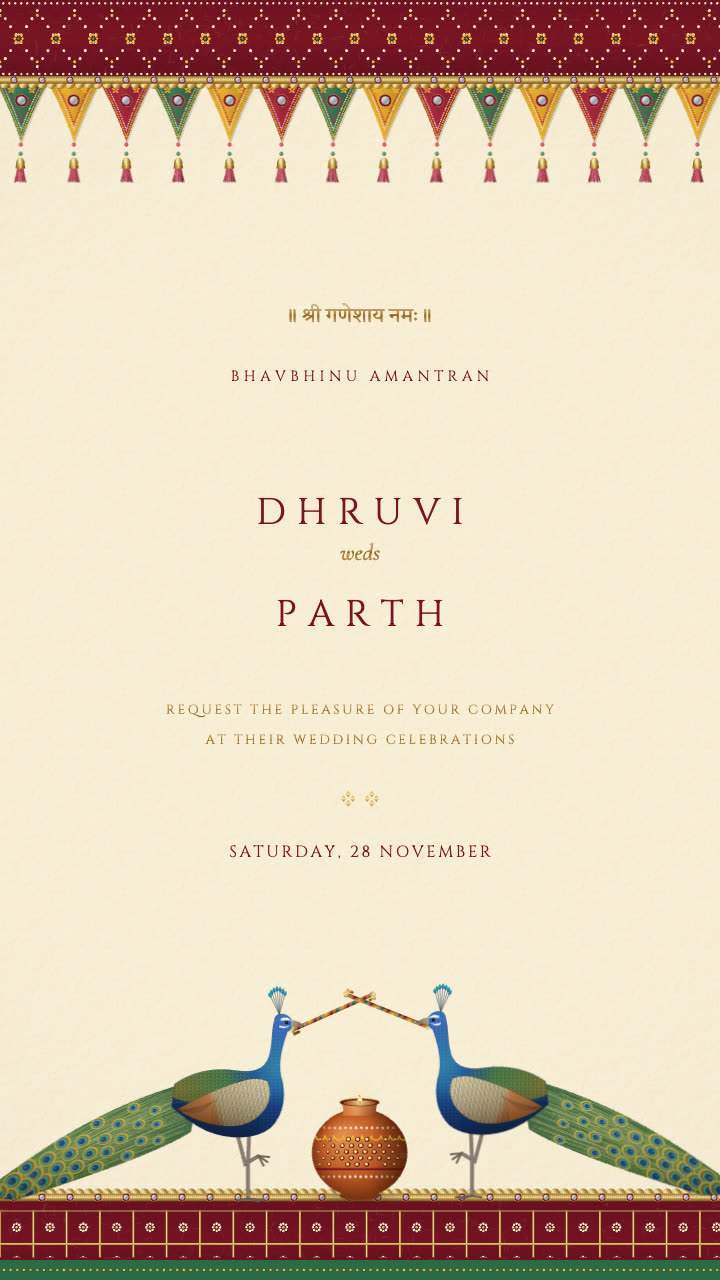
Bandhani, the tie-dyed cloth of tiny dots, and the gharchola that many Gujarati brides wear are a natural starting point. So is garba, which runs through so many Gujarati celebrations.
 Seen hereBandhaniWedding invitation · Gujarati
Bandhani uses bandhani and gharchola borders with mirrorwork toran flaps, and two peacocks dancing garba around a glowing garbo, their dandiyas meeting above the lamp. For the mehendi, Shagun is a brass thali heaped with henna leaves and filled cones beside a rose that slowly opens. See our Gujarati designs.
Maharashtrian
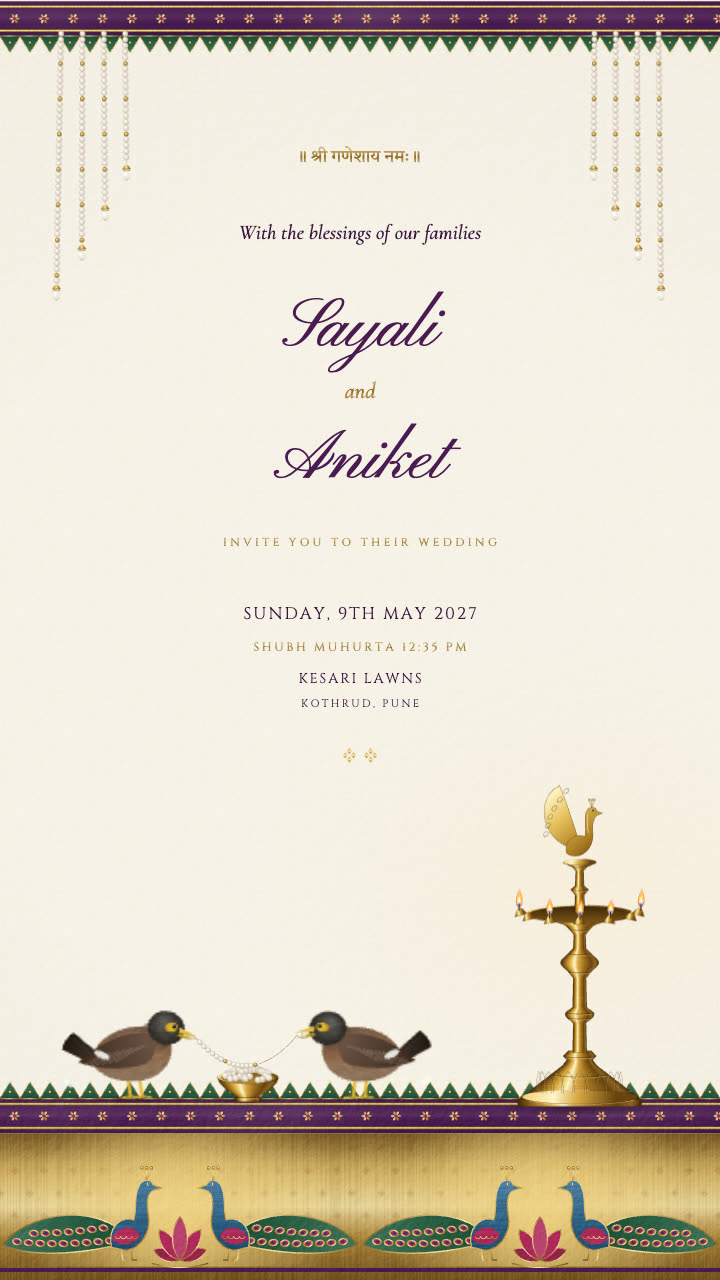
The Paithani sari, with peacocks woven into its zari pallu, is one of the most treasured textiles in a Maharashtrian home. The mundavalya, strings of pearls worn across the forehead by the bride and groom, is just as recognisable.
 Seen herePaithaniWedding invitation · Maharashtrian
Paithani unrolls a purple Paithani scroll on a woven pallu of zari peacocks, with mundavalya pearls and a brass samai, while two mynas are busy threading pearls into a mundavalya. Browse our Maharashtrian collection.
Sindhi
Ajrak, the block print of Sindh in deep indigo and madder red, is a beautiful frame for a Sindhi invitation. Sindhu uses fine ajrak block-print bands around a soft river, where a brass diya floats on a lotus leaf and paper boats carry tiny lamps downstream, one of them ferrying the folded wedding invitation. See our Sindhi designs.
South Indian wedding invitations: Tamil, Telugu and Malayali
Tamil
A Tamil wedding invitation can carry a great deal with very few elements: a kolam drawn in rice flour, a brass kuthuvilakku, jasmine, and the deep reds of Kanjivaram silk. Deepam has a Kanjivaram-red veil lifting on a lit kuthuvilakku, with a kolam on a red-oxide floor and banana plants at the threshold. Malligai moves to an old Chennai verandah with teak pillars and athangudi tiles, where a little palm squirrel draws the morning kolam. More in our Tamil collection.
Telugu
Talambralu, when the bride and groom shower each other with turmeric rice, is one of the most joyful moments of a Telugu wedding. Talambralu shows two sparrows on a brass plate of turmeric rice doing exactly that, under a mango-leaf thoranam and beside a purna kumbham crowned with a coconut. For a Hyderabad sangeet, Moti sets a silver tray of pearls and a cup of Irani chai on a balcony with Charminar glowing beyond. See our Telugu designs.
Malayali
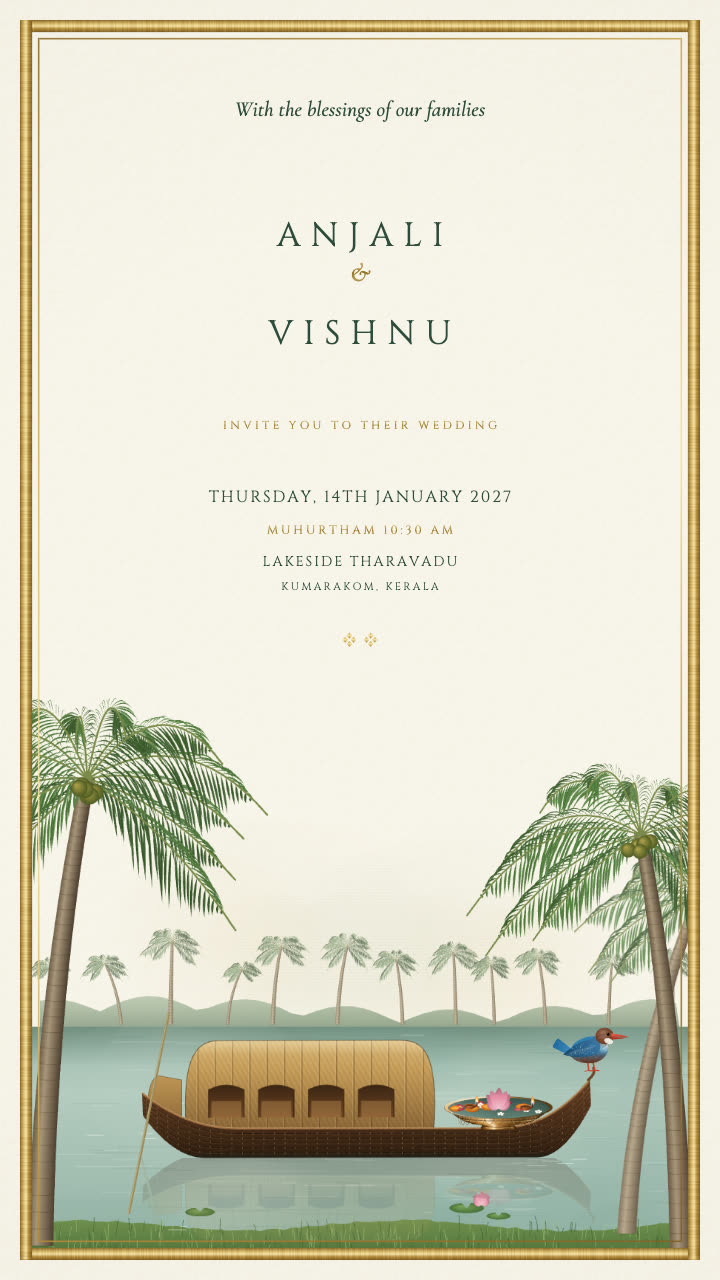
Ivory and gold belong to Kerala weddings, from the kasavu sari to the brass uruli.
 Seen hereKasavuWedding invitation · Malayali
Kasavu opens on the backwater and rises to an ivory card edged in gold kasavu. Below, a kettuvallam glides in carrying the wedding uruli of floating flowers and lamps, with a kingfisher riding on its bow. It is one of our calmest designs, and the plain ivory gives the words plenty of room. Browse our Malayali collection.
When two traditions share one card
Many couples come from two different homes: a Punjabi family marrying into a Bengali one, a Tamil bride and a Marwari groom. Both sides usually want to see themselves in the invitation.
It works best when the two traditions are given different jobs. One can supply the frame, the other the scene. A phulkari border around a pair of rui fish, say, or a kasavu edge around a Rajasthani jharokha. Keep a single colour palette so the card still reads as one piece. If both sides have strong colours, let one lead and use the other as an accent.
There is also a simpler route. Use one tradition's design for the wedding card and the other's for an event such as the mehendi or the sangeet, so each family has a card that feels like home. If you would like both on a single card, that is a new design drawn around your idea, which is what our custom commission is for.
The wording can follow the same thinking. Our guide to wedding invitation wording in Hindi and English includes the traditional opening lines many Telugu, Bengali, Tamil and Sikh families use.
Keep it restrained
The temptation with a community invitation is to include everything: the textile, the lamp, the flowers, the city, the ritual and the deity, all on one tall card. It rarely works. Crowded together, they cancel each other out.
One tradition, told clearly, says more than five told at once.
Choose the single detail your family would recognise first and let it lead. Give it a quiet background and leave space around the names. Guests will understand the rest. We wrote more about this in our note on what makes a luxury wedding invitation.
How to order
Choose a design from any of our community collections and write to us on WhatsApp with your names, dates and venues. Every card is illustrated in our studio, sized 1080 by 1920 for WhatsApp and Instagram, and personalised for your family. You will see a proof within 48 hours, and two rounds of changes are included.
A still invitation is ₹5,000, the same design animated and delivered as a video is ₹10,000, and an entirely new design, perhaps one that brings two traditions together, is ₹15,000.
 Next storyWedding Thank You Messages: What to Say After the Wedding
Explore the collection of luxury wedding invitations, or write to us on WhatsApp.