Wedding Invitation Timeline: When to Send Each Card
A complete wedding invitation timeline for Indian weddings, from save the date to thank you cards, with the ideal timing for each card.
A wedding is planned backwards. You fix the date, book the venue, and then count backwards to figure out when everything else must happen. Invitations work the same way.
Send them too early and guests forget. Send them too late and they have already made plans. The right timing gives people enough notice to travel, book leave, buy an outfit, and most importantly, to feel properly asked.
Here is the timeline we recommend in the studio, starting from the furthest point and working forward to the wedding itself.
Working backwards from your date
Before anything else, write down your wedding date and the date of your first event (often the mehendi or haldi, a day or two before the wedding). Every card you send is timed against these two dates.
The timeline below assumes a winter wedding. If your wedding is in the monsoon or summer, the same gaps apply, but you may have a little more flexibility since fewer guests will be travelling for other weddings at the same time.
Save the date: three to six months ahead
The save the date is not an invitation. It is a polite heads-up: here is our date, please keep it free, the formal invitation will follow. It goes out early so that guests can block their calendars before other weddings claim the same weekend.
For a wedding in your home city where most guests live nearby, three to four months ahead is enough. For a destination wedding in Udaipur or Goa, or when many guests will fly in from overseas, send it five to six months ahead.
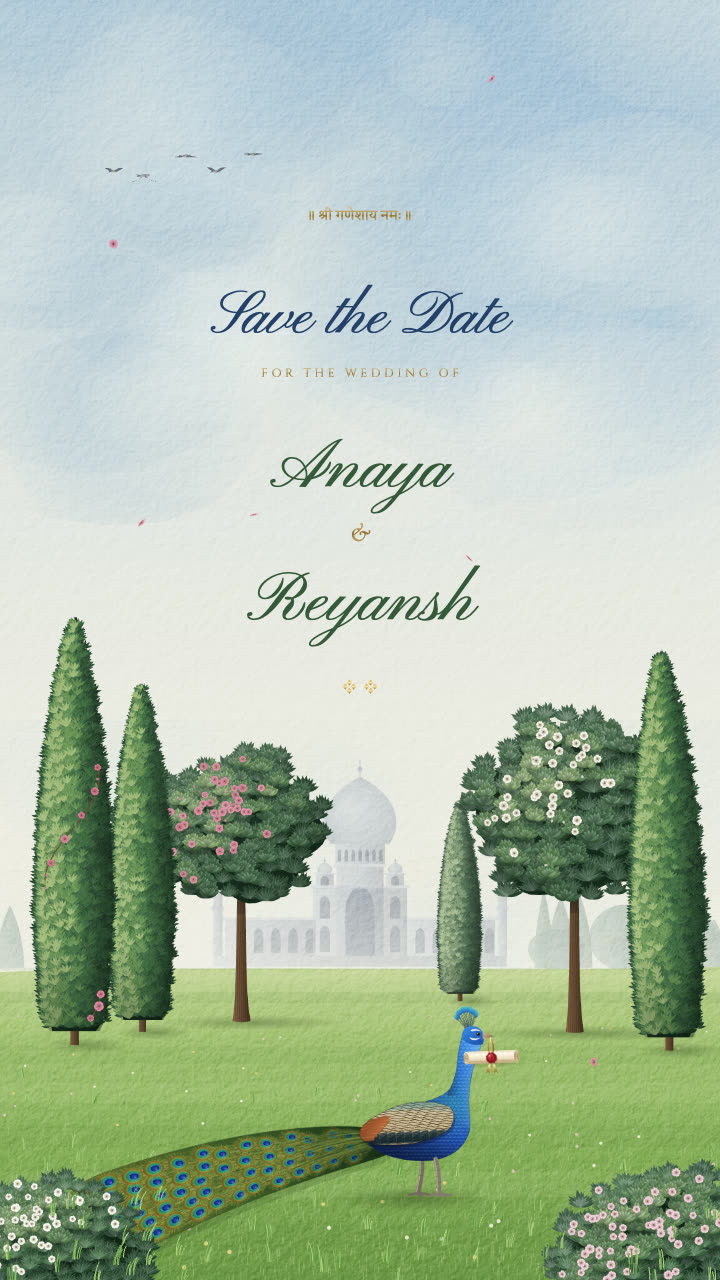 Seen hereBaghSave the Date invitation
Bagh captures this moment well: a peacock crosses a Mughal garden carrying a sealed invitation scroll in its beak, under a watercolour sky with cypresses, blossoming trees and a distant palace. The camera rises from the peacock to reveal the card. It comes as two cards: the save the date itself, and a second card with the city and the hosts.
What to include on the save the date: the couple's names, the date (or dates, if the celebrations run over several days), the city, and a line saying the formal invitation will follow. What to leave out: the full schedule of events, long lists of family names, and anything you are not yet certain of.
Our guide to save the date ideas for Indian weddings has more on wording, tone and designs.
Main invitation: six to eight weeks ahead
This is the card that carries the weight. It names both families, the bride and groom, the wedding date and time, and the venue. In many families it opens with a blessing or an invocation, and it closes with the names of the hosts.
Six to eight weeks before the wedding is the standard window. Earlier than that and the invitation sits forgotten. Later than that and guests struggle to arrange travel or take leave.
If your guest list includes people overseas, consider sending theirs a week or two earlier. A guest flying in from London needs more notice than a guest driving in from Ahmedabad.
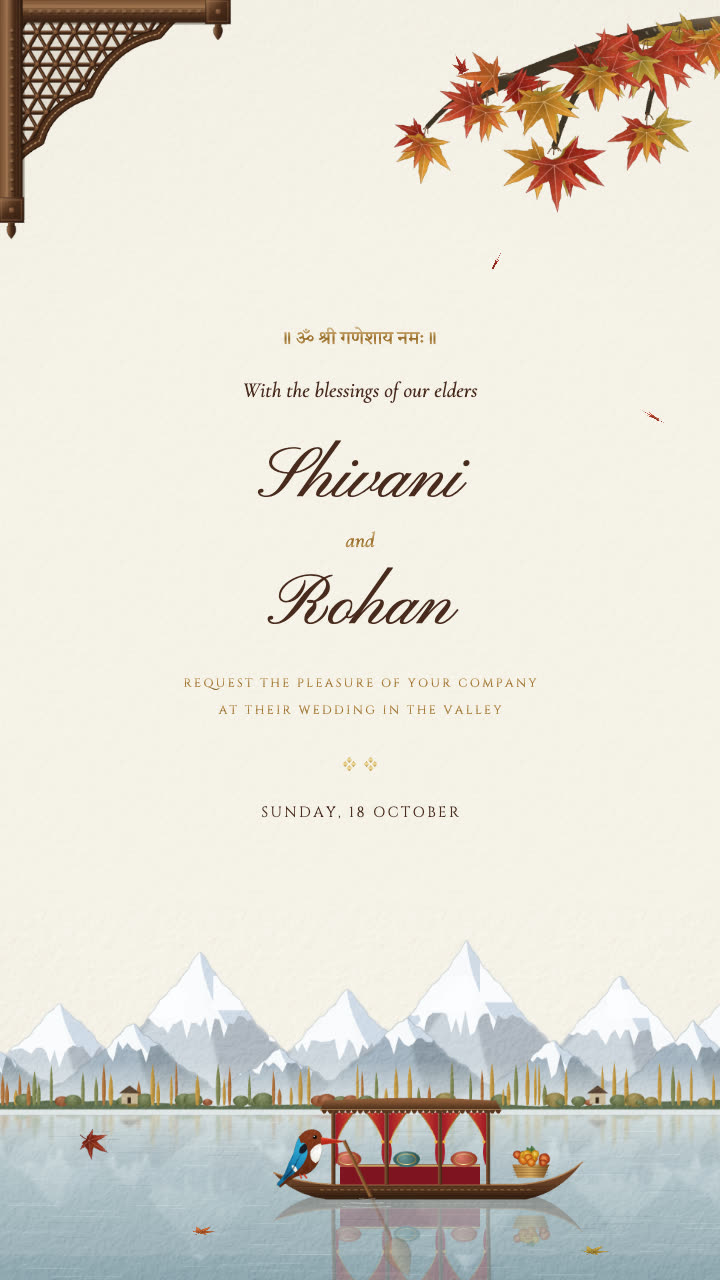 Seen hereChinarWedding invitation · Kashmiri
Chinar is our Kashmiri wedding design: chinar leaves drifting past a carved walnut window, snow mountains over the Dal, and a kingfisher rowing a shikara full of wedding flowers. It comes as three cards: invitation, events and thank you. The main invitation card carries the formal wording, while the events card lists all the functions in the days ahead.
For guidance on wording the main invitation, both formal and relaxed, see our post on wedding invitation wording in Hindi and English.
Event cards: alongside the main invitation
The haldi, mehendi, sangeet and any other functions before the wedding each deserve their own card. These can go out at the same time as the main invitation, or a day or two later.
Some families send event cards only to the guests invited to those smaller functions. Others send the full set to everyone and let the card explain who is welcome. Either way, the event card should name the function, the date, the time, the venue, and most importantly, the dress code.
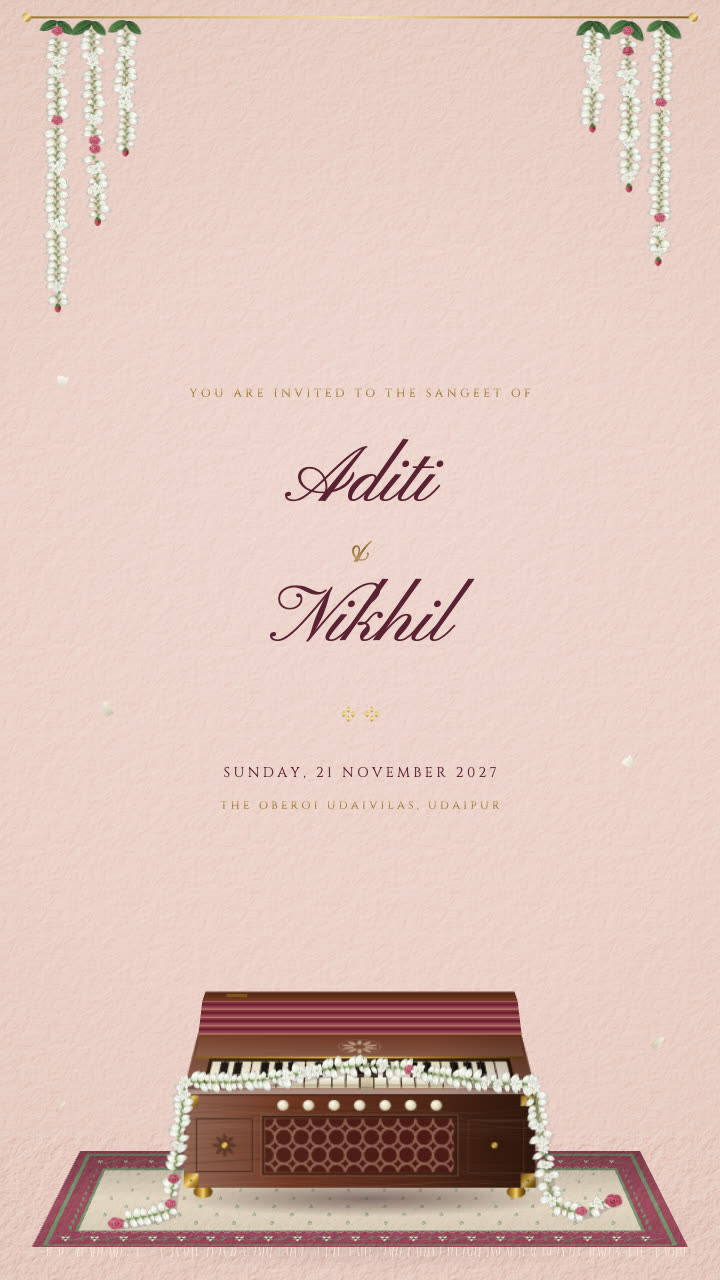 Seen hereSargamSangeet invitation
Sargam is a dusky rose and ivory sangeet card: a harmonium plays as if by an unseen hand, its bellows breathing and keys gently dipping while a string of mogra slips across them and jasmine petals drift down. It opens with a leaf reveal. Three cards: invitation, details and thank you.
For haldi and mehendi, guests want to know what to wear, whether a meal follows, and how long the mehendi artists will be there. For the sangeet, they want to know the dress code and whether there will be performances. Put all of this on the event card.
Reminder messages: one to two weeks ahead
A reminder is not a formal card. It is a short, warm message, often sent as plain text on WhatsApp, a week or two before the first event. It serves two purposes: it nudges guests who have not yet confirmed, and it reminds those who confirmed months ago.
A simple reminder might say: Just a week to go. We cannot wait to see you. Here is the schedule once more, and do let us know if you need any help with travel or stay. Attach the event card again, or a summary of the timings.
This is also the moment to send any last-minute details: the hotel address for the room block, parking instructions, or the dress colour for a particular function.
Reception card: if held separately
In some families the reception is a separate event, held days or even weeks after the wedding, often in another city. If this is the case, the reception card goes out on its own timeline, typically four to six weeks before the reception date.
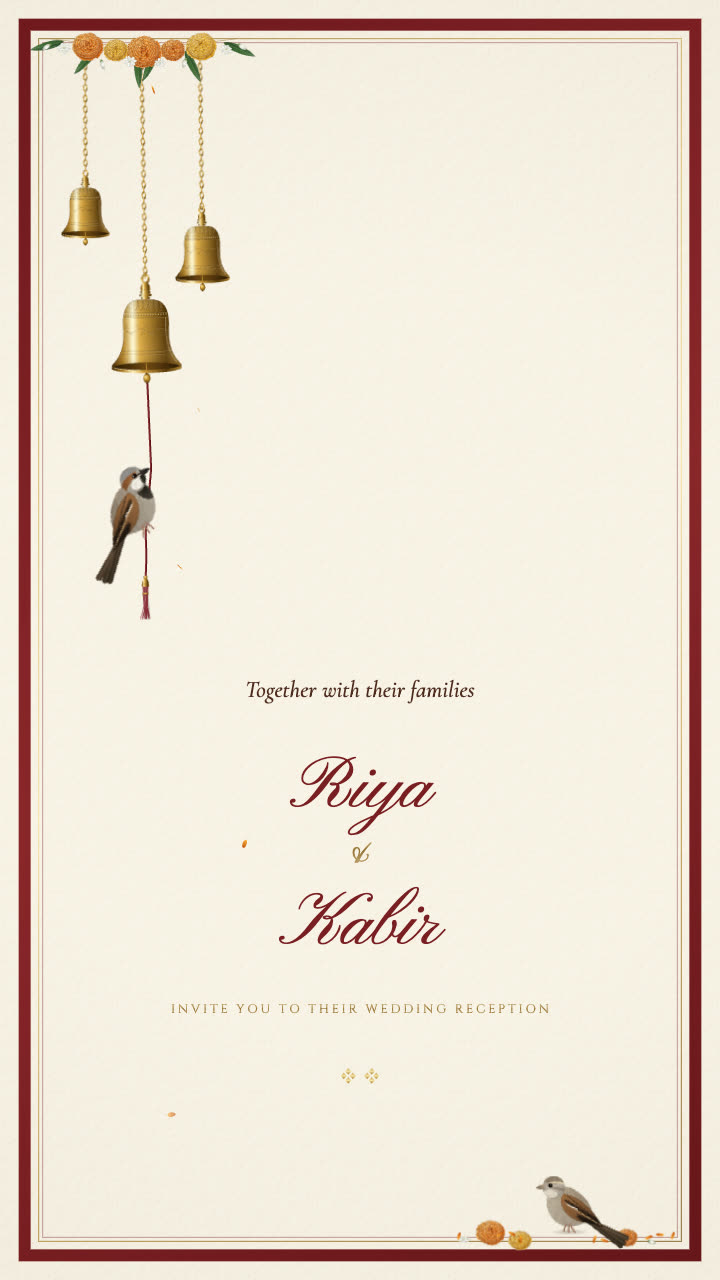 Seen hereGhantiReception invitation
Ghanti suits a reception beautifully: a little house sparrow clings to the silk cord of a brass temple bell and tugs, so the bell swings and softly rings. Carved doors open on it. Three cards: invitation, details and thank you.
If the reception is on the same day as the wedding, it is usually included in the events card rather than sent separately.
Thank you cards: after the wedding
The thank you card is the quietest card of all, and the one most often forgotten. It goes out a week or two after the wedding, to every guest who attended.
It does not need to be long. A few warm lines, a favourite photograph from the wedding, and the couple's names are enough. Many of our designs come as a set of three cards, with the thank you card already designed to match.
 Seen hereGulabiEngagement invitation
Gulabi is an engagement design, but its thank you card works just as well for a wedding: bougainvillea spilling over a summer sky, where two sparrows on swaying cane lanterns hold a red and gold thread with a ring on it. A cane peacock chair waits below. Three cards in the set.
Sending a thank you card is not strictly necessary, but it closes the loop. Guests gave their time, their travel, their gifts and their blessings. A small card that says thank you for being there is a lovely way to end.
A sample timeline
Here is a timeline for a wedding on 15 February:
- Mid-August to mid-September: Save the date goes out, especially to overseas guests and those who will travel far.
- Late December to early January: Main invitation and event cards go out, six to eight weeks ahead.
- First week of February: Reminder message on WhatsApp with the full schedule and any last-minute details.
- 13 to 16 February: The wedding week.
- Late February: Thank you card goes out.
Adjust each date for your own wedding. The gaps matter more than the exact dates.
Ordering your cards
Every Taarikh card is illustrated in our studio and delivered ready for WhatsApp and Instagram. A still card is ₹5,000 and an animated card, delivered as a video, is ₹10,000. If you would like a full set covering the save the date, the main invitation, each event and a thank you card, write to us on WhatsApp and we will quote the suite together.
Choose your designs from the collection, send us your names and dates, and we will return a proof within 48 hours, with two rounds of changes included.
 Next storyDress Codes on Indian Wedding Invitations: How to Word Them
Explore the collection of luxury wedding invitations, or write to us on WhatsApp.