Wedding Invitation Mistakes to Avoid Before You Hit Send
Common wedding invitation mistakes that slip past busy families, from typos and unclear timings to WhatsApp compression, and how to catch them early.
A wedding invitation carries the family's name, and there is no easy way to unsend one. Most mistakes are small and fixable before anyone notices. A few are embarrassing. One or two can genuinely confuse guests about where to be and when. This guide covers the errors we see most often, and how to catch them before you share.
Typos in names and dates
The most common mistake is also the easiest to make. A guest's name spelled differently from how they spell it. A date written as Saturday the 14th when the 14th is actually a Sunday. A year missing, or worse, last year's date carried over from an old draft.
Names are tricky because families spell them in different ways. Rashmi or Rashimi. Vikram or Vikrant. The safest approach is to ask the family directly, in writing, how they spell each name they want on the card. Then copy it exactly.
Dates need the same care. Write out the full date, including the year, and check it against a calendar. Read it aloud: "Saturday, the twenty-first of December, two thousand and twenty-six." If the day of the week does not match the date, you will hear it.
We always send a proof before finalising, and we ask families to read every word out loud. That simple habit catches more errors than any amount of silent scanning.
Wrong or missing venue details
Guests need to know exactly where to go. That means the venue name, the full address, and ideally a landmark or directions if the location is unfamiliar.
The mistakes we see: a venue name without a city. An address that matches the reception but not the wedding. A Google Maps pin that points to the wrong entrance. A venue that has recently changed its name, but the old name is still on the card.
Before you approve your invitation, search for the address yourself. Does the pin land in the right place? Is the venue name spelled the way the venue spells it? If there are multiple events at different locations, have you given the correct venue for each one?
 Seen hereTithiSave the Date invitation
Tithi is a save the date design where a breeze lifts the pages of an old tear-off calendar until the wedding date shows, already circled in red ink. It is a good reminder that every detail matters, including the small ones guests will return to when they need to find their way.
Unclear timing and event names
Guests should never have to guess what time to arrive. If the baraat departs at four in the afternoon and the pheras begin at six in the evening, say so. If the sangeet starts at eight but dinner is at ten, mention both.
The confusion often comes from event names. Not every guest knows the difference between a sagai and a roka, or whether the mehendi is only for women. A short line of context helps: "Mehendi, an afternoon of henna and music, for the ladies in the family." Or simply, "All are welcome."
If the wedding spans multiple days and cities, consider a small events card that lists everything in one place. Our designs come with separate cards for events and details, so guests can save the one they need.
Forgetting the dress code
Guests want to dress appropriately. They also do not want to overdress or underdress. A dress code, written kindly, is a favour, not a demand.
The mistake is leaving it out entirely, or writing something so vague that it does not help. "Indian formal" could mean anything. "Festive" is better. "Festive, in jewel tones" is better still. For a haldi, where turmeric will stain, a gentle note like "Yellows and whites, in clothes you do not mind ruining" saves everyone a dry-cleaning bill.
Our guide to wedding dress code wording covers suggestions for every event, from the haldi to the reception.
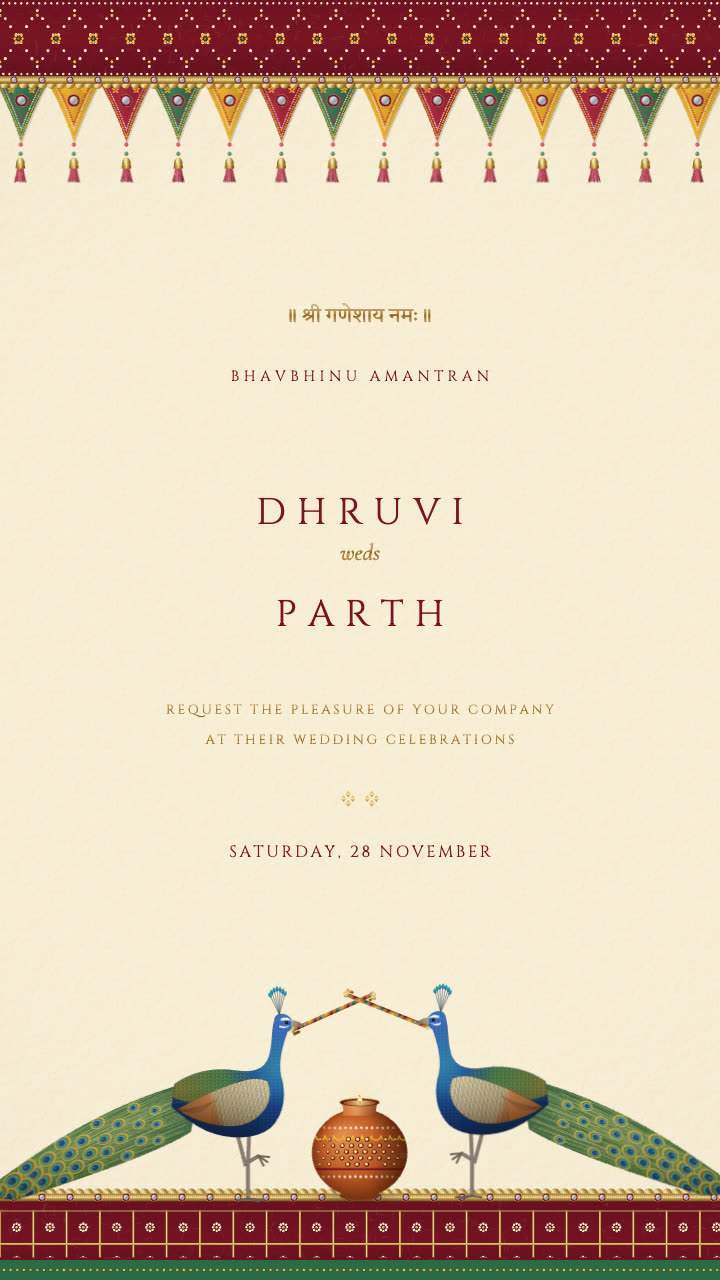 Seen hereBandhaniWedding invitation · Gujarati
Bandhani is a Gujarati wedding design with mirrorwork toran flaps, bandhani and gharchola borders, and two peacocks dancing garba around a glowing garbo. It is festive and colourful, the kind of card that gives guests a sense of the mood before they choose what to wear.
Sending too late
A save the date should go out two to three months before the wedding, earlier if guests will need to travel or book leave. The main invitation should follow four to six weeks before the date. For destination weddings, double those timelines.
The mistake is underestimating how long everything takes: finalising the guest list, agreeing on wording, waiting for a proof, making changes, and then actually sending. Families often start the process thinking they have plenty of time, and end up rushing the last week.
We send a proof within 48 hours, with two rounds of changes included, so the design itself is rarely the bottleneck. The bottleneck is usually the guest list or the wording. Start those conversations early, and the rest follows.
For more on timing, see our guide to digital wedding invitations in India.
WhatsApp compression and blurry videos
WhatsApp compresses images and videos before sending. A sharp, detailed invitation can arrive looking soft and pixelated if it is sent the wrong way.
The fix is simple. For still images, send as a document rather than a photo. Tap the paperclip icon, choose "Document," and select the image file. For videos, send as a document as well, or use a link to a cloud-hosted file if the video is large.
Every Taarikh invitation is sized at 1080 by 1920 pixels, the native resolution for WhatsApp stories and Instagram stories, and we deliver the files in formats that hold up well even after compression. Still, the way you send matters as much as the file itself.
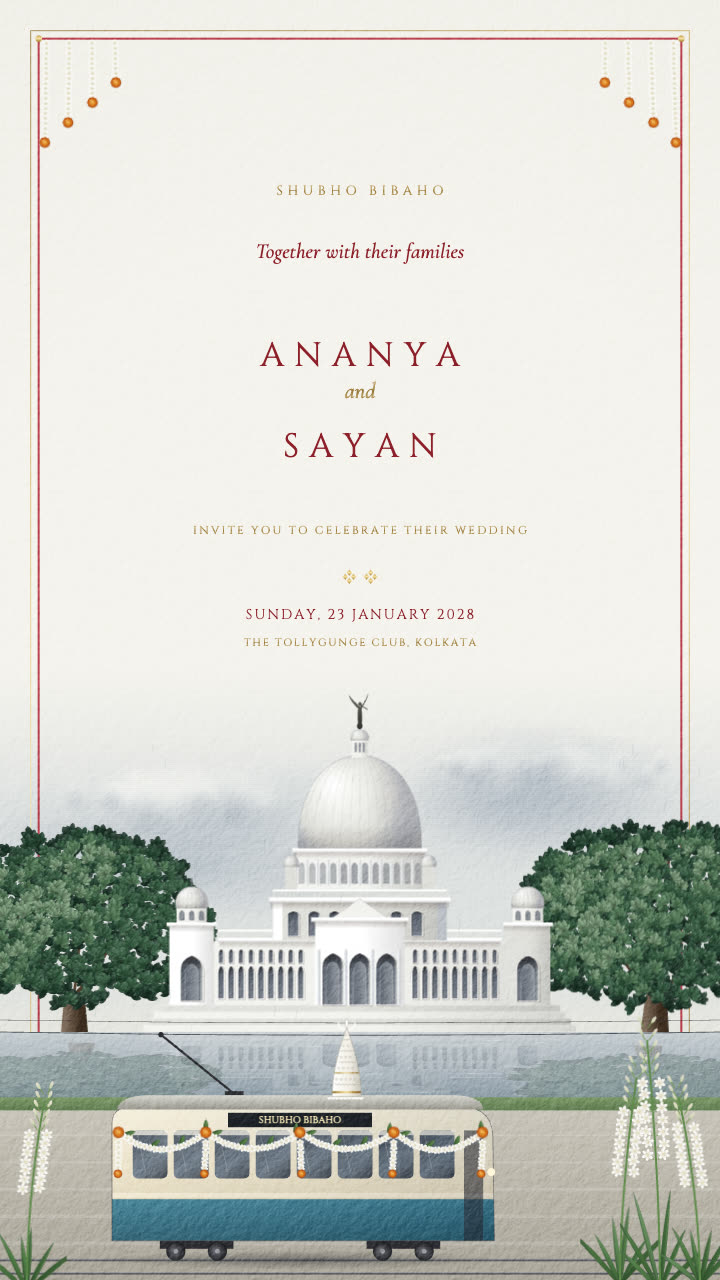 Seen hereKolkataWedding invitation · Bengali
Kolkata opens on a monsoon afternoon at the Maidan, where a tram strung with rajanigandha waits by the Victoria Memorial. It is a detailed, atmospheric design, the kind that deserves to arrive looking exactly as it was drawn.
Missing RSVP information
If you want guests to confirm their attendance, you need to tell them how, and by when.
Some families include a phone number. Others prefer a WhatsApp message to a specific contact. A few use a shared Google Form. Whatever the method, it should be clear, easy to follow, and attached to a deadline.
The mistake is assuming guests will know to reply. They may not. They may also forget, especially if the invitation arrives weeks before the event. A gentle reminder a week before the RSVP deadline, sent personally, usually helps.
A final read before you send
Before you approve your final proof, run through this list:
- Every name is spelled the way the family spells it, in both scripts if you are using Hindi and English.
- The date matches the day of the week, and the year is correct.
- Every venue has a full address, and the address matches the event.
- Timings are clear for every event, and guests know what each event is.
- A dress code is mentioned, at least for the main events.
- RSVP instructions are included, with a deadline and a contact.
- You have sent the file as a document, not a photo, to avoid compression.
If you catch a mistake after the proof is approved, let us know. We include two rounds of changes, and small fixes are often quicker than you expect.
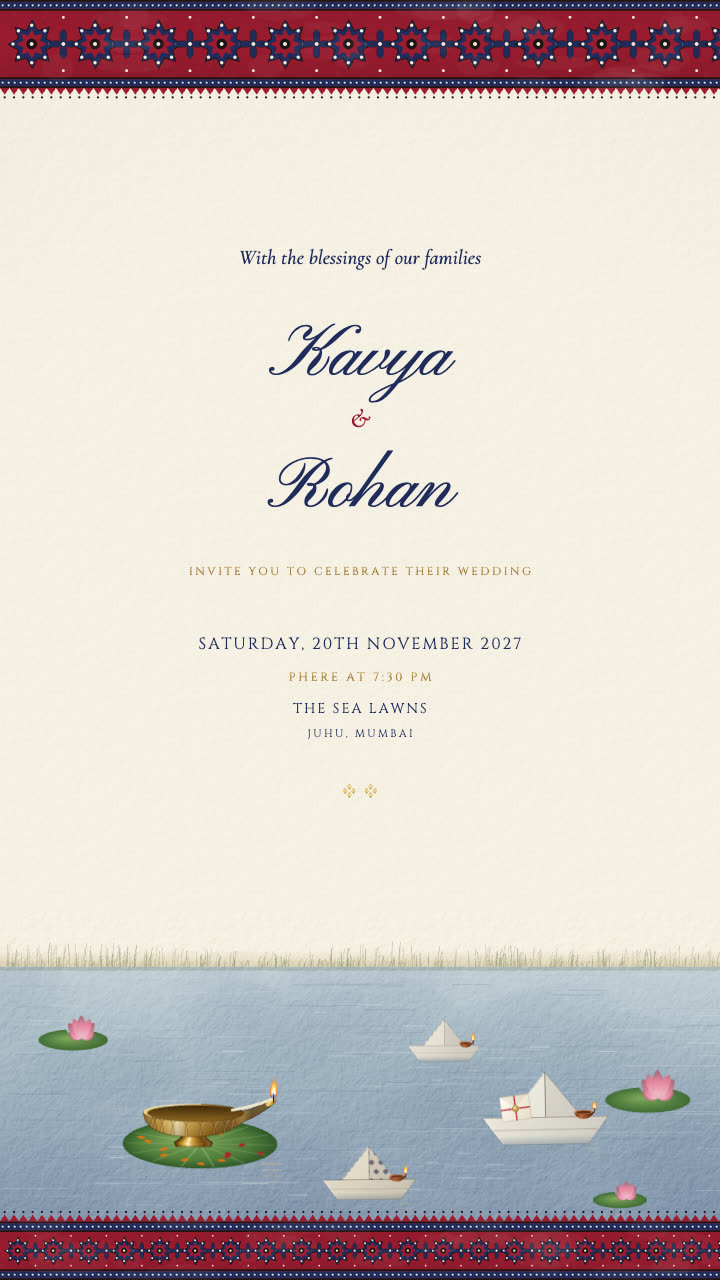 Seen hereSindhuWedding invitation · Sindhi
Sindhu is a Sindhi wedding design with fine Ajrak block-print bands and brass diyas floating on a soft river. It is quiet and precise, the kind of card where every detail is intentional. That is the feeling you want your guests to have when they open your invitation: nothing rushed, nothing overlooked.
How to order
Write to us on WhatsApp with your names, dates and venues. We will send a proof within 48 hours, and two rounds of changes are included. A personalised still invitation is ₹5,000. The same design gently animated, delivered as a video, is ₹10,000. A new design drawn around your idea is ₹15,000.
 Next storyWedding Invitation Timeline: When to Send Each Card
Explore the collection of luxury wedding invitations, or write to us on WhatsApp.