Engagement and Reception Invitations: Ideas and Wording
Ideas and sample wording for roka, sagai, ring ceremony and wedding reception invitations, with notes on tone, timing, dress codes and matching sets.
The engagement opens the celebration and the reception closes it. One is small and full of nerves, the other large and full of relief. Both deserve a proper invitation, and both are easy to get slightly wrong, because they borrow so much from the wedding card that families forget how different they are.
Here are our notes on each, with sample wording you can borrow. We have used the names Meera Sethi and Kabir Bhatia throughout; replace them with your own.
How the engagement card differs from the wedding card
The wedding card speaks for two families and several generations. The engagement card is closer and quieter. A few things follow from that.
- The guest list is smaller. Often it is only the two families, close relatives and a handful of friends. The card can be warmer and more personal because everyone reading it knows the couple.
- The tone is lighter. There is less ceremony to explain. A short line of joy usually says more than a long formal paragraph.
- One card is often enough. If the roka and the ring exchange are on the same day, a single invitation with the timings below is perfectly clear.
- The blessing line is optional. Many families still place a small line to Shri Ganesh at the top, but an engagement card without one does not feel incomplete.
Roka, sagai or ring ceremony
Families use different words for this event, and the right one matters.
The roka is the first formal step in many North Indian families: the two families meet, exchange gifts and blessings, and the match is settled. It is often small and held at home. The sagai is the engagement proper, usually with the exchange of rings, and sometimes a tilak for the groom. Many families now hold the two together. The ring ceremony is simply the English name, and it suits a card written mostly in English or sent to friends from other communities.
Other traditions have their own words. Maharashtrian families hold a sakharpuda, Gujarati families a gol dhana, Sindhi families the misri, and many Bengali families an ashirbaad. If your family uses one of these, put it on the card, with the English underneath if some guests will need it.
Wording for the engagement
From the parents, formal:
Neelam and Arjun Sethi invite you to the engagement of their daughter Meera with Kabir, son of Ritu and Sanjay Bhatia.
From the couple, warm and short:
Meera and Kabir are getting engaged. Come and watch them exchange rings, and stay for dinner.
For a roka at home:
A small gathering for a big moment. Join us for the roka of Meera and Kabir, at home in Vasant Vihar.
In Hindi:
चि. कबीर एवं सौ. कां. मीरा की सगाई के शुभ अवसर पर आप सादर आमंत्रित हैं।
रोका की रस्म में आपकी उपस्थिति हमारे लिए आशीर्वाद होगी।
A closing line for the engagement card can be gentle and a little playful: the wedding card will follow, we promise.
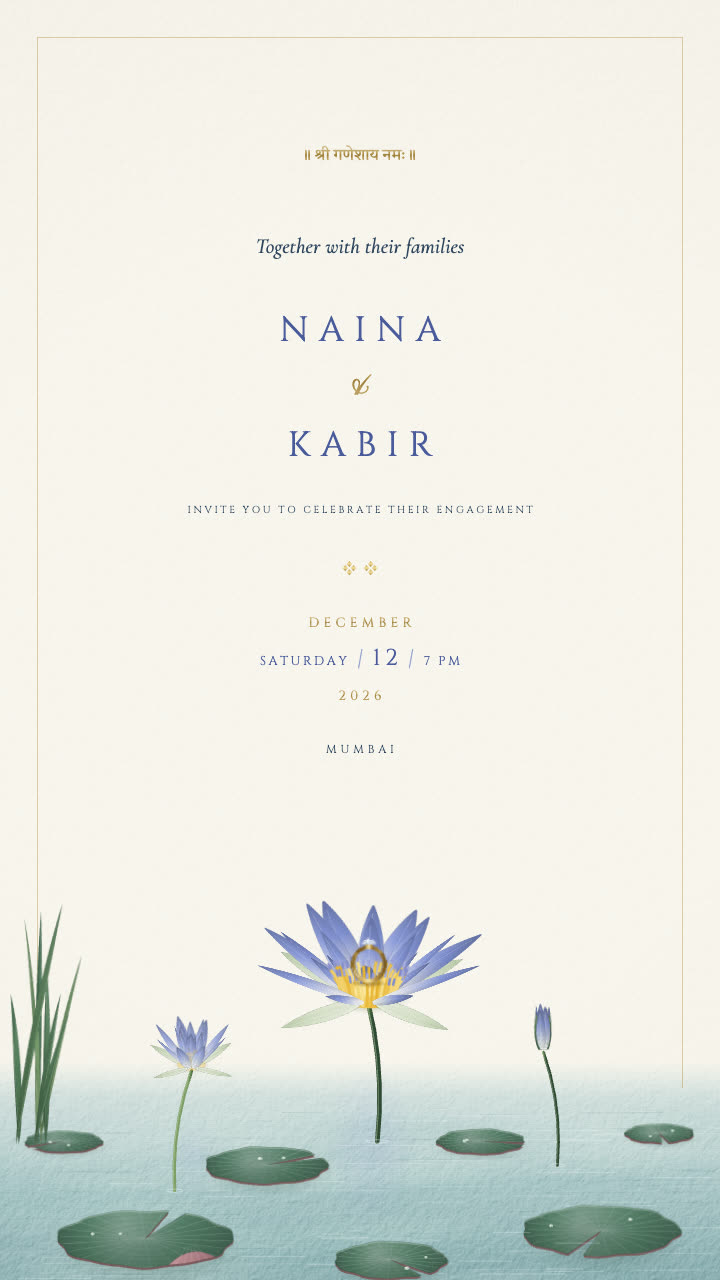 Seen hereNeelkamalEngagement invitation
Neelkamal is built around a single quiet moment. A blue water lily bud rests on a still pond and slowly opens, petal by petal, to reveal an engagement ring on its golden heart. It comes as three cards: the invitation, the events and a thank you.
 Seen hereGulabiEngagement invitation
For a summer engagement, Gulabi is brighter. Bougainvillea spills over a summer sky, two sparrows on swaying cane lanterns hold a red and gold thread with an engagement ring on it, and a cane peacock chair waits below. If you like a softer, more classical look, Koyal has two koels on a mango branch, one offering the other a ripe mango with a tiny gold ring slipped round its stalk. You can see them all in our engagement collection.
How the reception card differs
The reception is the most public event of the wedding. It is usually held in the evening, often a day or two after the wedding, and in many families it is hosted by the groom's parents in their own city. The bride's family may host one of their own as well.
That changes the card in several ways.
- The guest list is wider. Colleagues, neighbours, business associates and friends who could not travel for the wedding are all here. Write for readers who may not know the family well.
- The couple are already married. The card welcomes them as a couple, not as two families coming together. Ask the bride how she would like her name to appear, and do not assume.
- It is formal, but not ritual. There is no muhurat to explain. The card needs a clear start time, a venue and, very often, a dress code.
- The colours can go deeper. Evening receptions suit midnight, emerald, navy and silver, colours that would feel heavy on a haldi card.
Wording for the reception
From the groom's parents:
Ritu and Sanjay Bhatia request the pleasure of your company at the reception of their son Kabir and his bride Meera. Sunday, 26 April, 8 in the evening.
From the couple:
We are married. Now come and celebrate with us. Kabir and Meera, Sunday, 26 April, from 8 in the evening.
With a dress code:
Dress code: evening formal. Indian, Western or somewhere in between.
In Hindi:
नवदम्पति को आशीर्वाद देने हेतु आशीर्वाद समारोह में आप सपरिवार सादर आमंत्रित हैं।
प्रीतिभोज में आपकी गरिमामयी उपस्थिति प्रार्थनीय है।
Because many reception guests will not have been to the wedding, a short line about the couple is a kind touch: Kabir and Meera were married in Udaipur on 22 April.
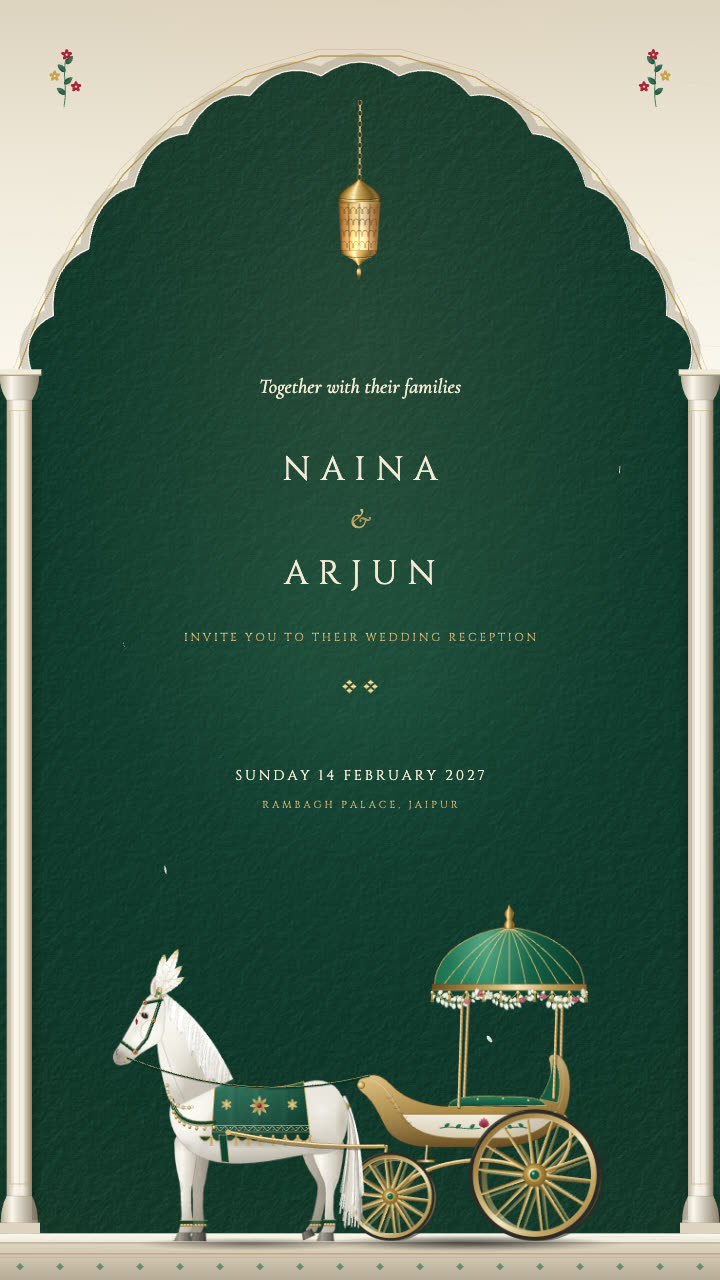 Seen hereBaggiReception invitation · Marwari
Baggi suits a grand evening. Under a white marble palace porch, a Marwari horse in emerald and gold waits with the wedding carriage, tossing his head so the plume on his brow flicks. It is drawn in deep emerald and gold, across three cards.
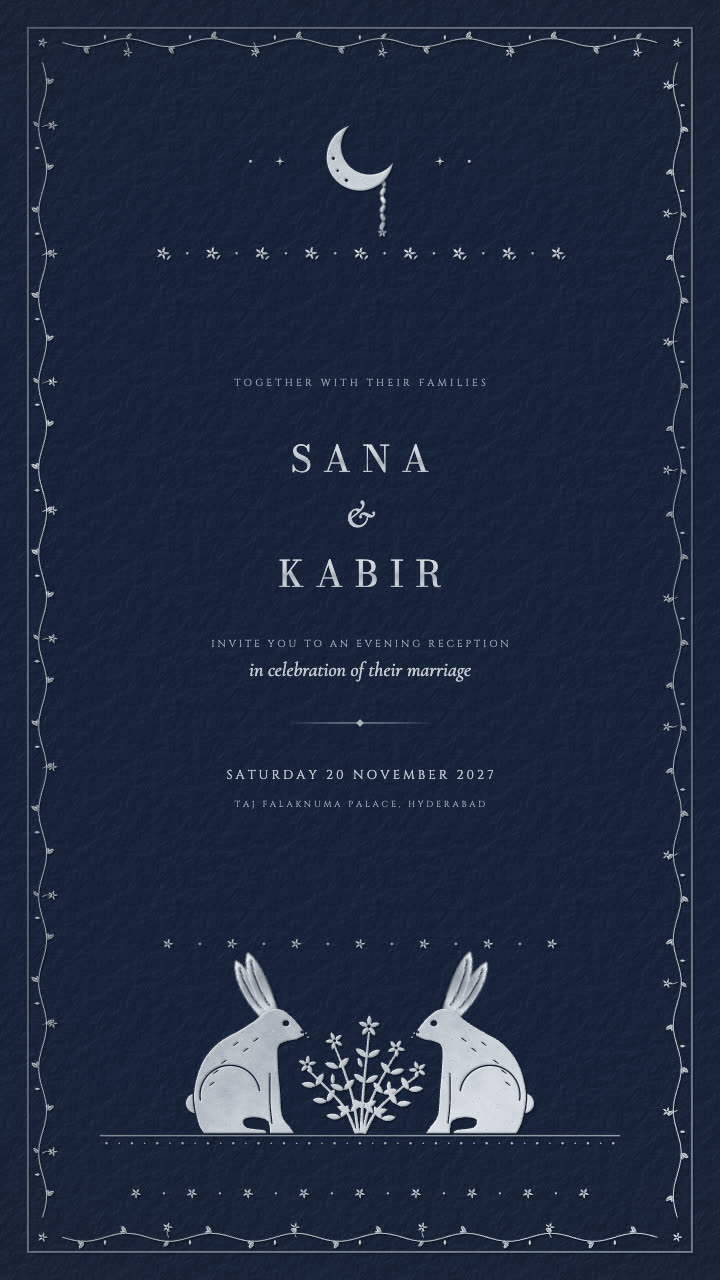 Seen hereChandiReception invitation
Chandi is quieter and very elegant at night: silver foil on deep navy, with a jasmine vine border, a crescent moon trailing a string of jasmine buds, and two hares face to face beside a flowering jasmine bush, while moonlight sweeps the silver. For something warmer, Choodi has a stack of ruby glass and gold bangles catching the candlelight, one rolling slowly across the table to rest against a single red rose. More in our reception collection.
Timing
The two events sit at opposite ends of the calendar, and the cards follow.
- Engagement: two to three weeks ahead is usually enough, since the guests are close family. A roka planned at short notice can go out a week before.
- Reception: send it with the wedding card or just after, ideally four to six weeks before. Out of town guests need time to plan, and colleagues need time to keep the evening free.
If the engagement and the wedding are months apart, a save the date can bridge the gap. Our note on digital wedding invitations in India covers how families now send the whole set on WhatsApp.
Making them feel like one set
The engagement card, the wedding card and the reception card are often designed months apart, which is how a celebration ends up with three cards that look like they belong to three different families. A little planning avoids this.
- Choose one or two colours that carry through. The engagement can be lighter and the reception deeper, but a shared gold or a shared green ties them together.
- Keep one type style. The same lettering for names across every card is the simplest way to make a set feel intended.
- Repeat a motif. A lotus on the engagement card can return at the foot of the reception card.
- Keep the wording voice consistent. If the wedding card is formal and in the parents' names, a breezy reception card from the couple can feel abrupt. Either is lovely; mixing them takes care.
For the main card, our guide to wedding invitation wording in Hindi and English has formal samples for every kind of host.
Ordering your engagement or reception card
Every Taarikh invitation is illustrated in our studio and personalised with your names, dates and venues. Choose a design, send us your wording on WhatsApp in English, Hindi or both, and we will send a proof within 48 hours, with two rounds of changes included. Cards are 1080 by 1920, sized for WhatsApp and Instagram. A still card is ₹5,000, an animated one, delivered as a video, is ₹10,000, and an entirely new design is ₹15,000. If you would like your engagement or reception card to echo your wedding card, tell us when you write.
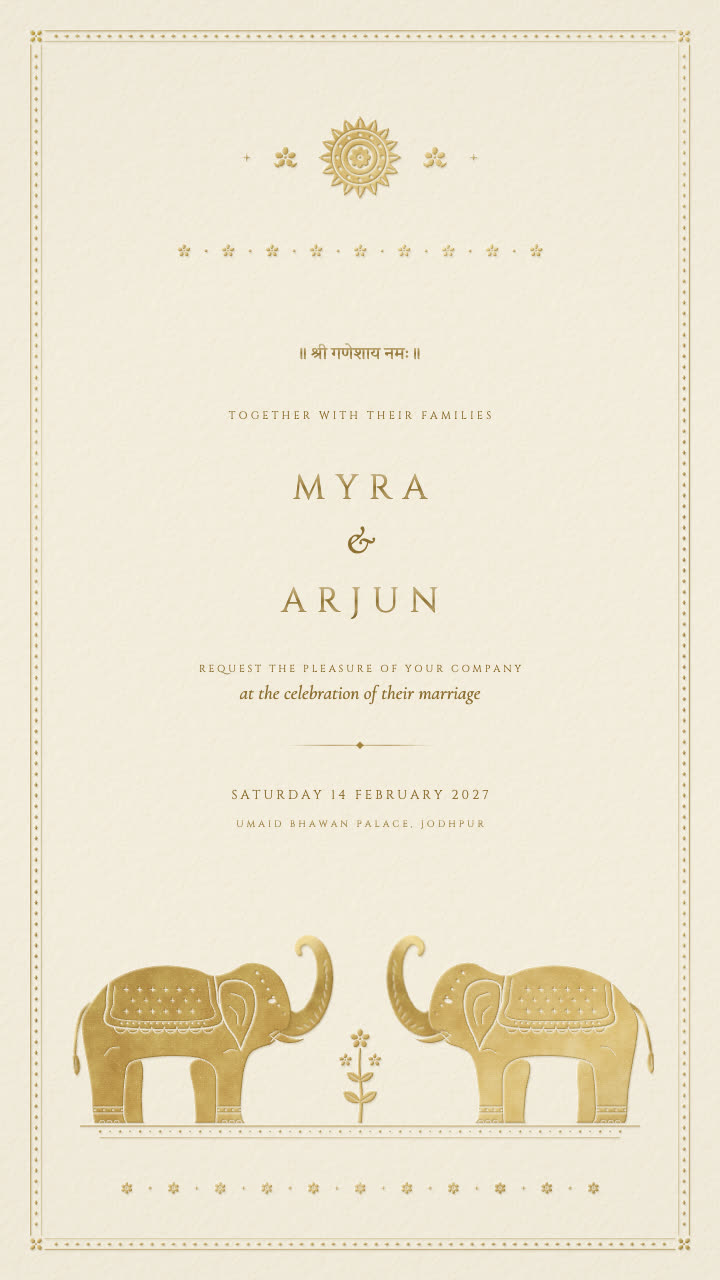 Next storyGold Foil and Vintage Wedding Invitations, Drawn for the Screen
Explore the collection of luxury wedding invitations, or write to us on WhatsApp.