Bilingual Wedding Invitations: Hindi and English on One Card
How to design a bilingual wedding invitation with Hindi and English together, with layout ideas, font pairing tips and regional language guidance.
Most Indian weddings invite guests in two languages. The elders read Hindi, Gujarati or Bengali. The cousins abroad read English. A single card must speak to both, without crowding either.
This is not just a matter of translation. It is a question of layout, of choosing which words go where, and of pairing two scripts so they feel like one card and not two halves glued together. Below are our notes on designing a bilingual invitation that honours both languages, with ideas for Hindi and English, and for other regional scripts as well.
Why bilingual, not two separate cards
Some families send one card in Hindi and another in English. That works, but it doubles the design work and can feel disjointed. A well designed bilingual card does something more: it shows that both languages belong together, that the family moves between them naturally, and that the guest, whichever language they read first, is seeing the same invitation.
A bilingual card is also easier to share. On WhatsApp, one card goes to everyone. The uncle in Indore and the cousin in London see the same thing, and that shared card becomes a small part of the wedding itself.
Three ways to lay out two languages
There is no single rule for where Hindi and English should sit on a card. It depends on how much text you have, how formal the tone is, and which language feels primary to the family. Here are three approaches that work.
Stacked: one language above the other
The most common layout. Hindi at the top, English below, or the other way round. The language at the top reads as slightly more important, so most families put the one their elders will read there.
This works best when both versions are roughly the same length. If the Hindi is three lines and the English is ten, the card will look unbalanced. Keep both concise.
Side by side: two columns
Hindi on the left, English on the right, or the reverse. The two languages share the card equally, and the guest's eye can move between them. This suits a more formal invitation where both versions are short and parallel.
The risk is width. On a phone screen, two columns of small text can be hard to read. If you choose this layout, keep the wording tight and the type large enough to read without pinching to zoom.
Parallel cards: one language per card
For designs with multiple cards, you can give each language its own card. The first card in Hindi, the second in English, both in the same set. This keeps each card clean and gives each language room to breathe.
We often suggest this for families sending a three card set. The invitation in Hindi, the events card in English (or both), and the thank you in whichever language feels warmer.
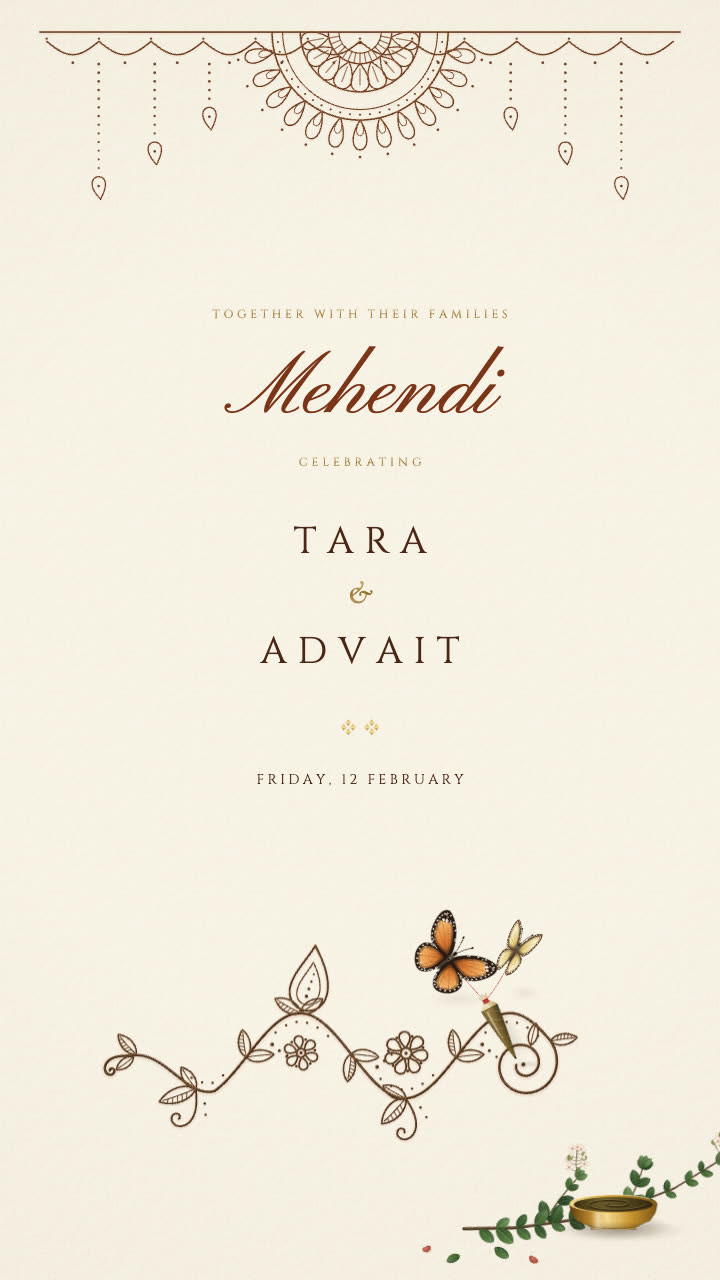 Seen hereBelMehendi invitation · Marwari
Bel is a mehendi invitation with two butterflies carrying a henna cone, its tip drawing a fine vine across the card. It comes as three cards, which gives room for Hindi on one and English on another, with the closing note in whichever language suits.
Pairing fonts across scripts
Devanagari and Latin scripts have different rhythms. Devanagari has a headline at the top, called the shirorekha, that runs across the letters. Latin has ascenders and descenders that vary the height. Putting them together takes care.
A few principles that help:
- Match the weight. If the English is in a light serif, the Hindi should be equally light. A heavy Hindi headline over a thin English subhead looks mismatched.
- Match the formality. A calligraphic Hindi script pairs with an elegant English serif. A clean Hindi sans pairs with a modern English sans. Mixing a formal script with a casual one feels odd.
- Give each script its own size. Devanagari often needs to be set slightly larger than Latin at the same point size to look equally legible. We adjust this when we set your card.
- Keep the same margins. Both blocks of text should sit within the same frame, with equal breathing room, so they feel like one design.
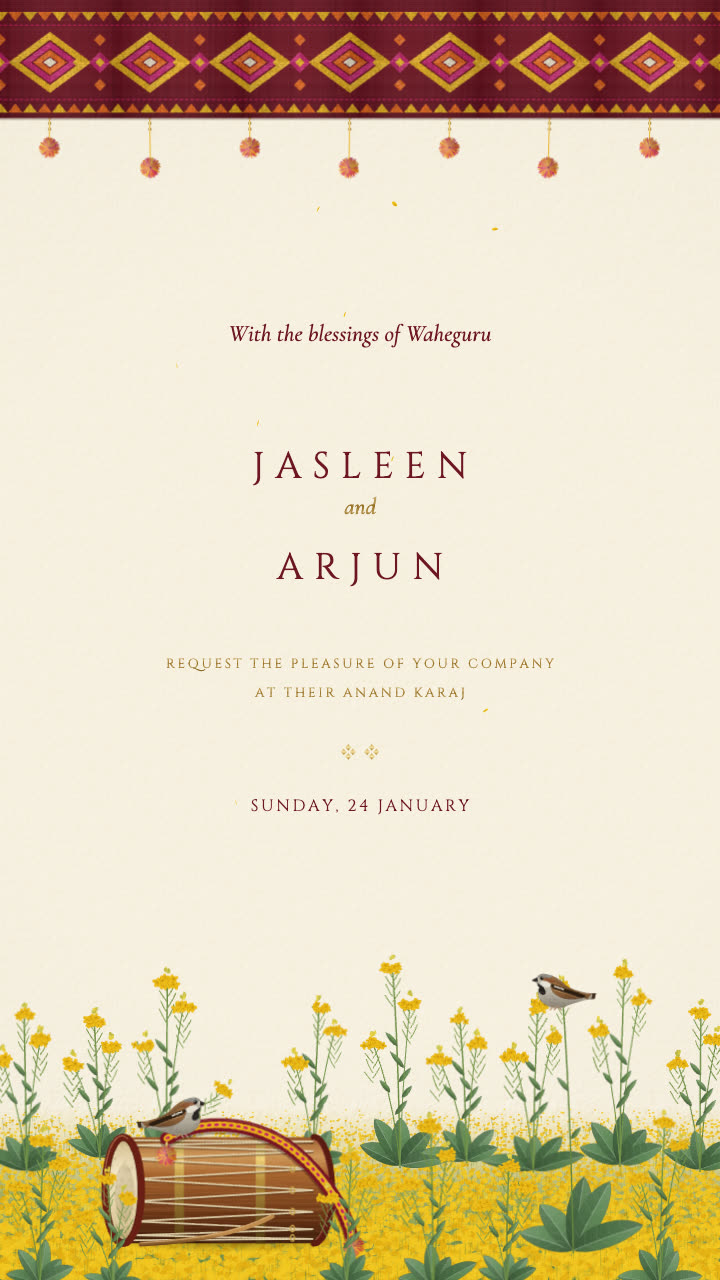 Seen herePhulkariWedding invitation · Punjabi
Phulkari frames the words in a hand-stitched phulkari border with silk tassels. Its centre is open, which makes it easy to set Hindi above English or the other way round without the text competing with the illustration. Browse our Punjabi collection for more designs that hold both scripts well.
Choosing what to say in which language
You do not have to translate every word. Some things read better in Hindi, others in English, and a bilingual card can mix them.
A few patterns families use:
- Blessing line in Hindi, names and venue in English. The shloka or prayer at the top stays in Sanskrit or Hindi, because that is the tradition. The names and details below are in English, because they are easier for everyone to read.
- Host names in both, events in English. The parents' names appear in Hindi and in English, so both scripts carry the family's name. The event details (date, time, venue) are in English only, since they are factual and do not need translation.
- Hindi for the main card, English for the events card. The formal invitation is in Hindi for the elders. The events card, with its list of dates and locations, is in English for clarity.
Our guide to wedding invitation wording in Hindi and English has sample lines and honorifics you can borrow for each approach.
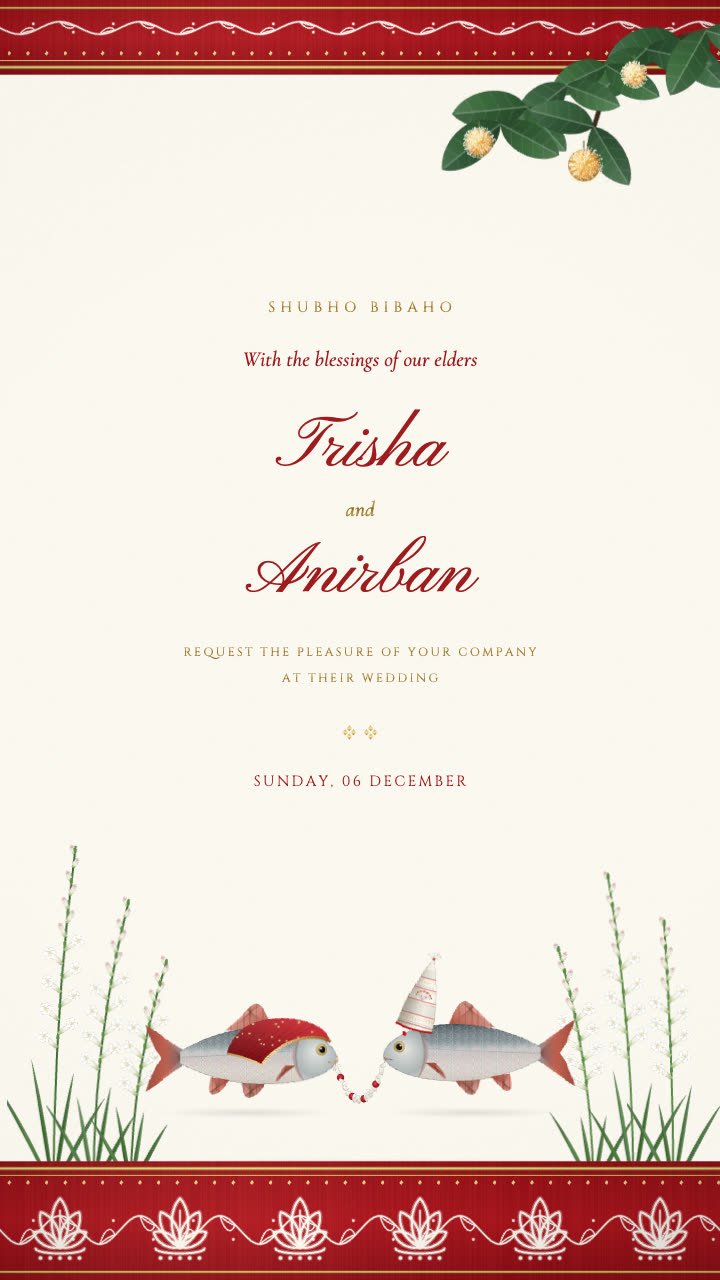 Seen hereAlponaWedding invitation · Bengali
Alpona was drawn for a Bengali wedding, with red laal paar borders painted with white alpona and two rui fish dressed as bride and groom. Bengali families often use Bengali at the top, Hindi in the middle and English at the foot, and this card's three card format gives room for all three. See our Bengali collection for more.
Beyond Hindi: regional languages
Hindi and English are the most common pair, but many families want a third language: Gujarati, Bengali, Tamil, Telugu, Marathi, Punjabi or Malayalam. The same principles apply, with a few extra notes.
- Keep to two scripts on one card. Three scripts on a single card can feel crowded. If you need Gujarati, Hindi and English, consider putting Gujarati and Hindi on one card (both in Devanagari, if the family prefers) and English on another.
- Check the script with an elder. Regional languages have their own honorifics and opening lines. The Tamil pillaiyar suzhi, the Bengali prajapataye namah, the Telugu srirastu are not interchangeable. Ask before you write.
- Let the design guide the choice. A design drawn for a Tamil wedding, like Deepam or Malligai, will carry Tamil script more naturally than a Rajasthani haveli.
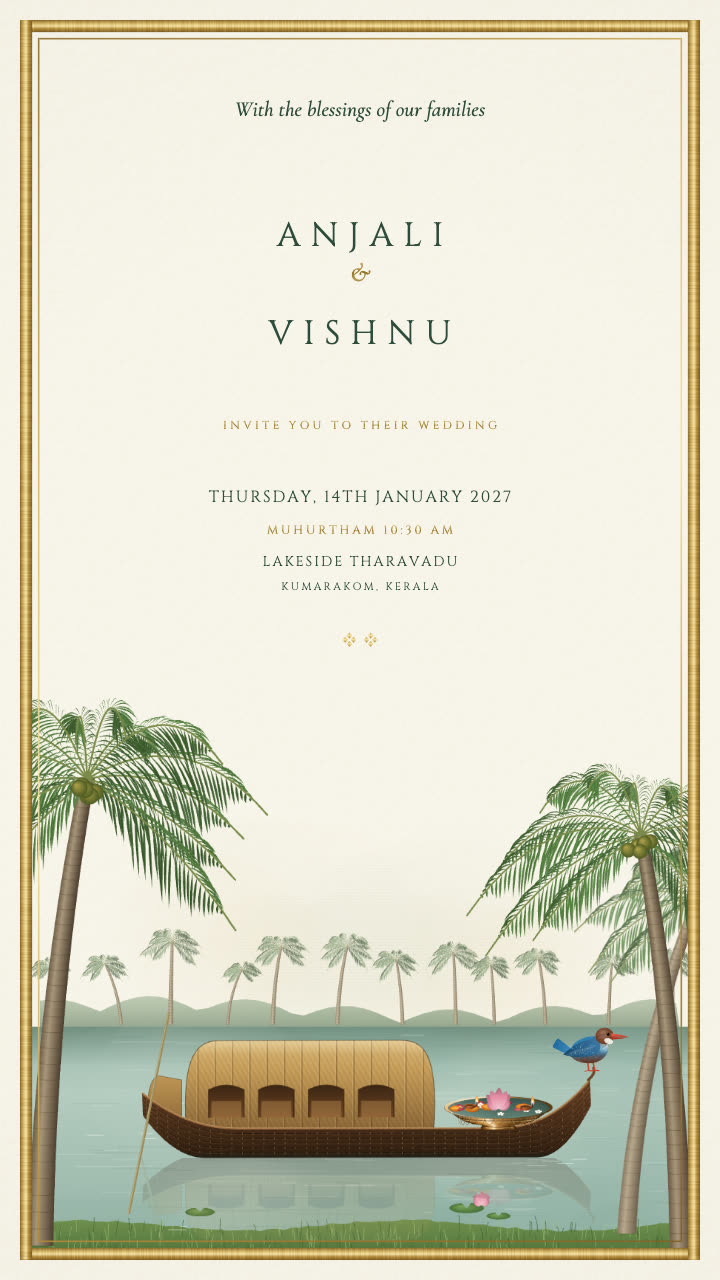 Seen hereKasavuWedding invitation · Malayali
Kasavu was drawn for a Malayali wedding: a kettuvallam glides through the backwaters carrying a wedding uruli of floating flowers and lamps. Malayalam script sits beautifully on this card, with English below. See our Malayali collection.
A few small things that matter
- Spell names the same way in both scripts. If the English says Aarav, the Hindi should say आरव, not a variant.
- Use the same date format. If the English says Saturday, 14 February, the Hindi should say शनिवार, 14 फरवरी, not a different calendar.
- Keep the same tone. If the English is warm and personal, the Hindi should be too. A formal Hindi opening over a casual English closing feels like two different invitations.
- Read both aloud. A card that looks balanced may sound unbalanced. Read the Hindi to an elder, the English to a cousin, and ask if anything feels missing.
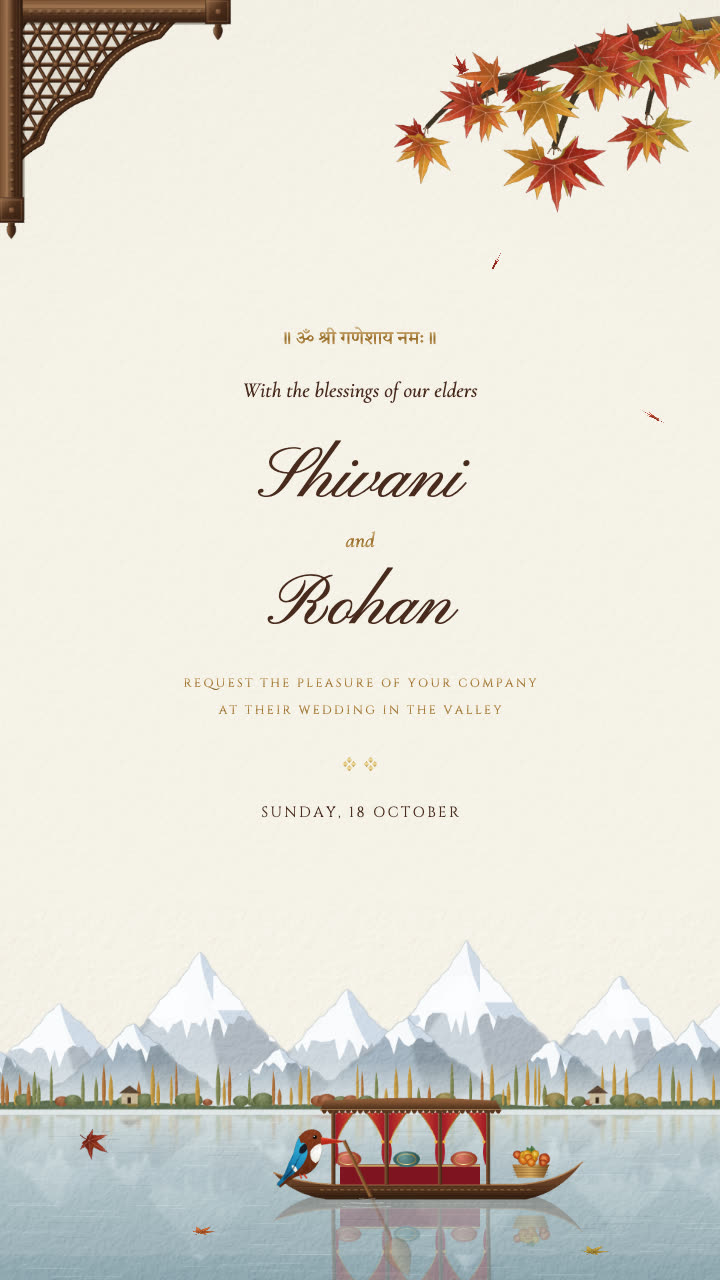 Seen hereChinarWedding invitation · Kashmiri
Chinar is a Kashmiri design: chinar leaves drifting past a carved walnut window, snow mountains over the Dal, and a kingfisher rowing a shikara full of wedding flowers. Kashmiri families often use Urdu, Hindi and English together, and this card's three card set gives room for each. See our Kashmiri collection.
Ordering a bilingual card
Every Taarikh invitation is illustrated in our studio and set with your names, dates and wording. Share your text on WhatsApp in Hindi, English or both, and we will set it with care, Devanagari and regional scripts included. You will see a proof within 48 hours, with two rounds of changes included. A still card is ₹5,000, an animated one ₹10,000, and an entirely new design drawn from your idea ₹15,000. Cards are 1080 by 1920, sized for WhatsApp and Instagram.
 Next storyHow to Choose Your Wedding Invitation Design
Explore the collection of luxury wedding invitations, or write to us on WhatsApp.