How to Choose Your Wedding Invitation Design
A guide to choosing your wedding invitation: start from venue and vibe, match your aesthetic, think about family, decide still or animated, and trust what feels right.
There are fifty designs in our collection and, on any given week, a few more taking shape in the studio. When a couple writes to us saying they love everything and cannot decide, we understand. A wedding invitation is a small thing that carries a great deal of feeling, and no one wants to get it wrong.
Over the years we have seen how families arrive at the right card. Some know in seconds; others take a week of quiet thinking. The path is rarely the same, but a few questions help almost every time.
Begin with where you are getting married
The first and often the easiest place to start is the venue. If you are marrying in Jaipur, a card drawn with pink stone and pigeons will feel like home. If the ceremony is at a temple at dawn, a card with diyas and kolam will carry that stillness. If your wedding is outdoors under old trees, a garden scene will echo the day your guests are about to see.
This does not mean the card must be literal. A lakeside palace card works beautifully for a family who simply loves Udaipur, even if the wedding is in Delhi. But when in doubt, what helps is to picture the moment your guests arrive and ask what feeling you would like the invitation to have prepared them for.
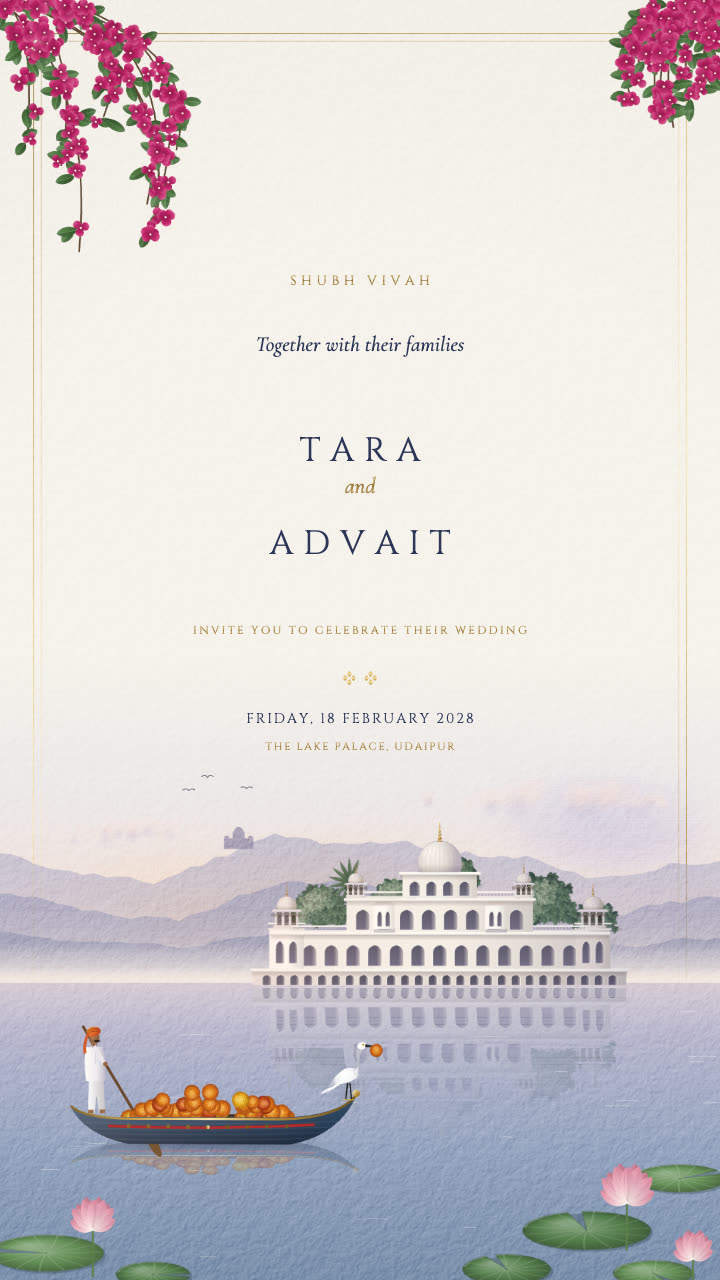 Seen herePicholaWedding invitation · Marwari
Pichola is drawn for that lakeside feeling. At dusk on Lake Pichola a boatman rows a boat heaped with marigolds toward the Lake Palace, a little egret riding the prow with a flower in its beak. It is a suite of three cards, invitation, events and thank you, and suits a Udaipur wedding or a family drawn to the lake.
Think about your look as a couple
You have probably discussed colours, outfits and flowers by now. Look at those choices and ask what they say about you. Are you drawn to heritage and tradition, or to clean lines and quiet tones? Do you reach for florals and gold, or do you prefer the sparseness of block print?
A couple who loves old things, worn brass, grandfather clocks and vintage saris, will feel at home with a design painted like an antique natural-history plate. A couple who keeps a calm, modern home may prefer a foil card with nothing but metal and light. The card does not have to match every decor choice, but it should feel like something you would have chosen together.
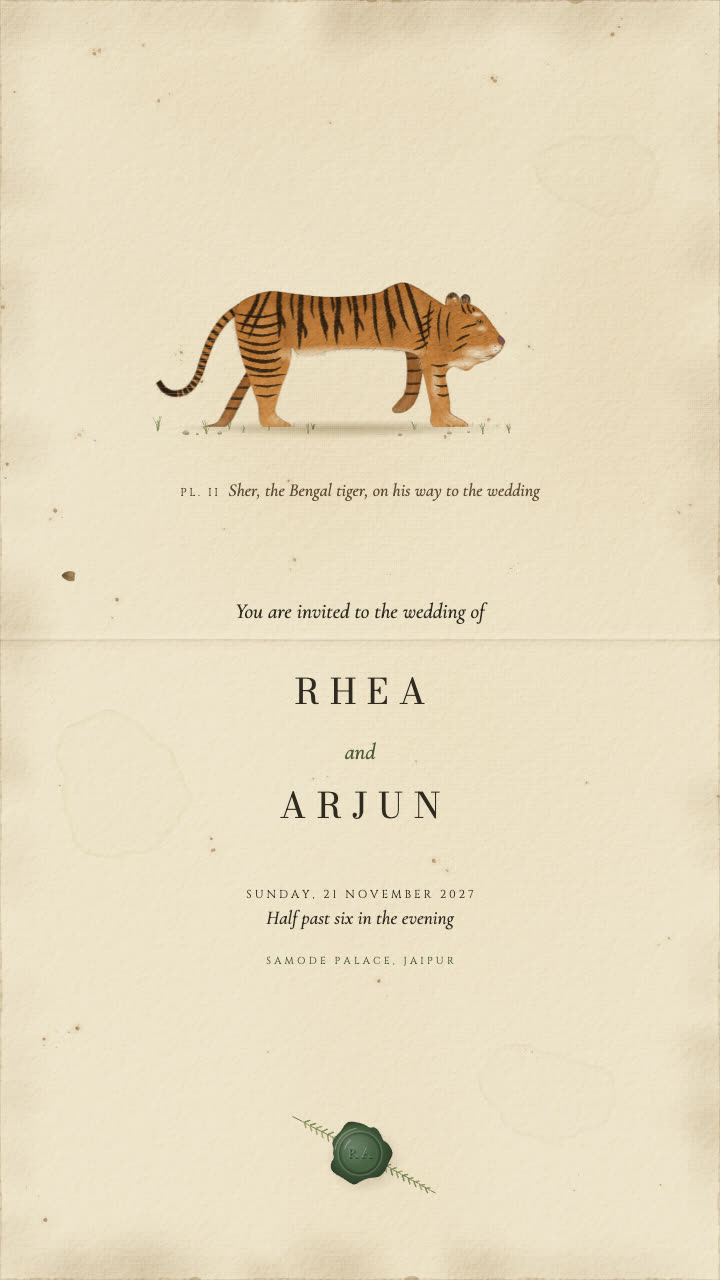 Seen hereSherWedding invitation
Sher speaks to a couple who loves antiques. A Bengal tiger walks across an aged natural-history plate, every stripe and hair laid in fine Company School brushwork, above the couple's names and a green wax seal with a pressed fern. It comes as three cards and sits well with families who have an old-world sensibility.
Match your wedding palette, or let the card set it
Some families choose their invitation first and let the colours ripple outward to the decor and outfits. Others have already decided on deep emerald and ivory, or blush and gold, and want the card to echo those tones.
Either approach works. What matters is that the invitation does not clash with the day. If the mandap will be white and green, a card in scarlet and saffron will feel out of step, even if each is beautiful on its own.
Browse by colour in your mind. Picture the card beside your wedding photos and ask whether they belong to the same world. If you are unsure, lean toward softer tones. Ivory, cream, blush, jade and champagne gold tend to sit quietly beside most palettes, while bright colours ask for company.
Our note on wedding invitation colour palettes has more on this, with pairings that tend to work.
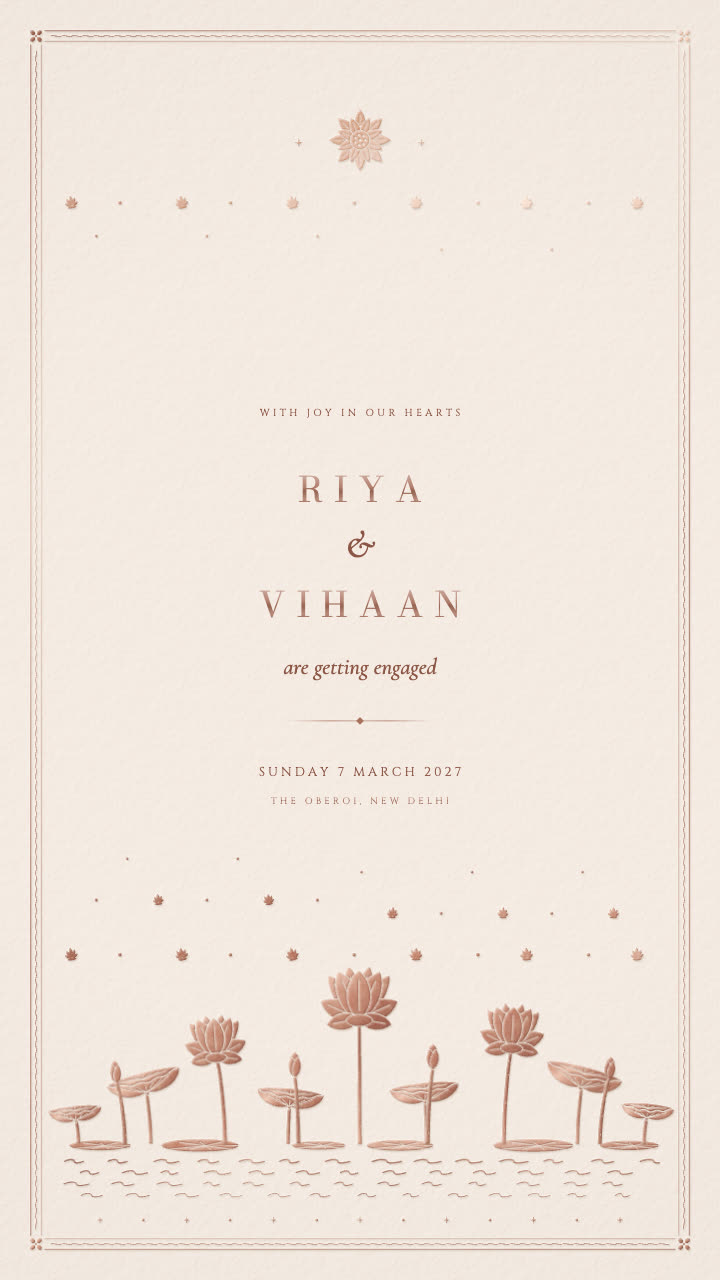 Seen hereKamal TaalEngagement invitation
Kamal Taal is drawn in rose gold foil on blush cotton paper: a lotus pond along the foot of the card, tiny lotus butis scattered around a calm centre and a lotus rosette above. The lotuses sway and light glides across the foil. It is an engagement card in three pieces, and its soft colours fit almost any palette.
Consider your families
An invitation is sent from the family, and it should feel like the family. If your elders are formal and traditional, a playful card with cartoon birds may not carry the weight they expect. If your family has always been warm and relaxed, a stiff, grand card may feel borrowed.
Think, too, about the grandparents and aunts who will receive it. An animated card is lovely when guests will watch it on their phones, but if many of your elders prefer WhatsApp voice notes to videos, a still card may be the wiser choice. A still invitation can also be printed and framed for those who treasure paper.
Some families split the difference: an animated card for the main invitation, sent to the younger crowd, and a still version of the same design for the elders. Since every animated design in our collection is drawn as a finished illustration first, the still version never feels like a lesser one.
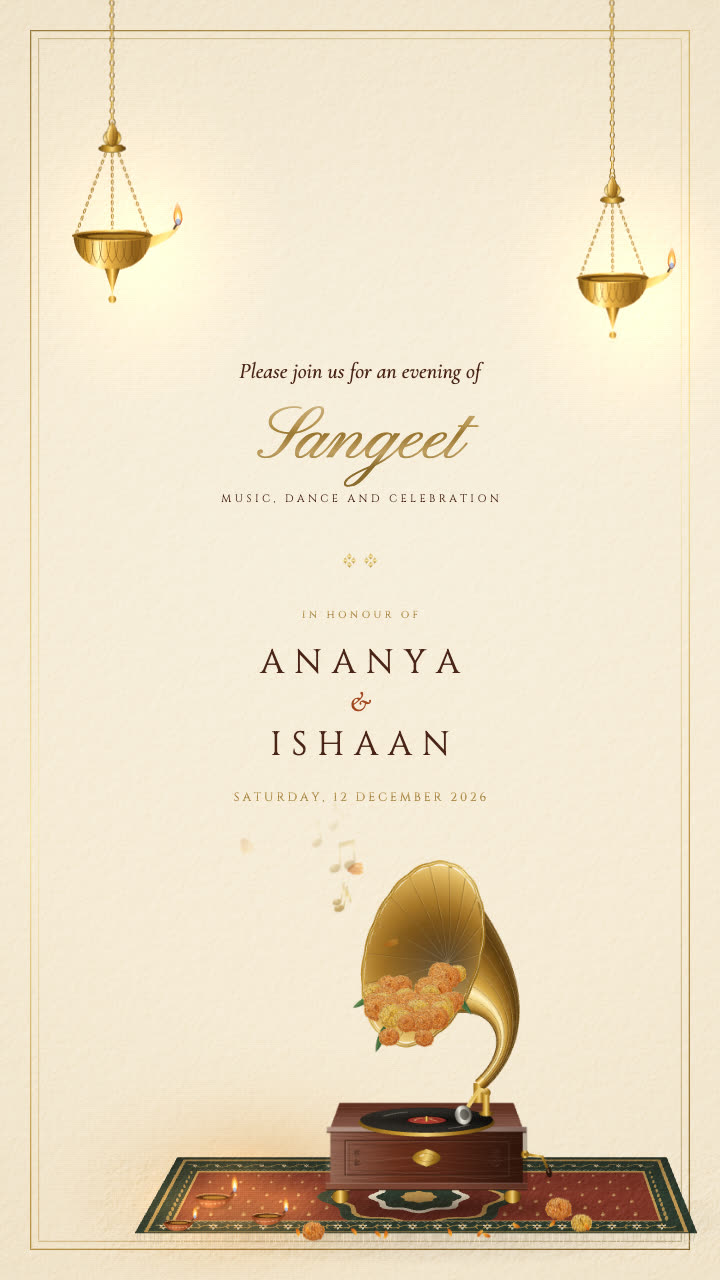 Seen hereMehfilSangeet invitation
Mehfil is a candlelit evening: an old gramophone plays on a rug, its horn heaped with marigolds, the record turning and the needle arm riding the groove as tiny gold notes and a few loose petals float out. It is a sangeet invitation in three cards. The warm nostalgia in it appeals to older guests who remember those gramophones, while the gentle animation delights the younger ones.
Still or animated
The question of still versus animated deserves a few more words, because it shapes what guests receive.
A still invitation is a single image, 1080 by 1920, sized for a WhatsApp chat or an Instagram story. Guests can look at it as long as they like, zoom in on the detail, screenshot it and print it. It is ₹5,000.
An animated invitation is a short video, the same dimensions, delivered as an MP4. It has one lovely moment (a flower opening, a door folding back, a swing in the breeze) and then settles into a gentle loop. It catches the eye in a chat full of messages, and guests often watch it more than once. It is ₹10,000.
Neither is better. If your design has fine detail you would like guests to study, a still may serve it better. If your design has a moment you want guests to experience, animation brings it to life. Our guide to animated wedding invitations has more on what makes the moving version good.
Trust what you feel
After all the thinking, the best guide is your own instinct. When you open a design and feel a small lift of joy, when you picture sending it to your best friend and smile, that is the one.
Do not talk yourself out of a card you love because you think another might be more appropriate. Do not pick a design you admire but do not feel. The invitation will go out with your names on it, and the feeling it carries will be your feeling, not ours. Trust what moves you.
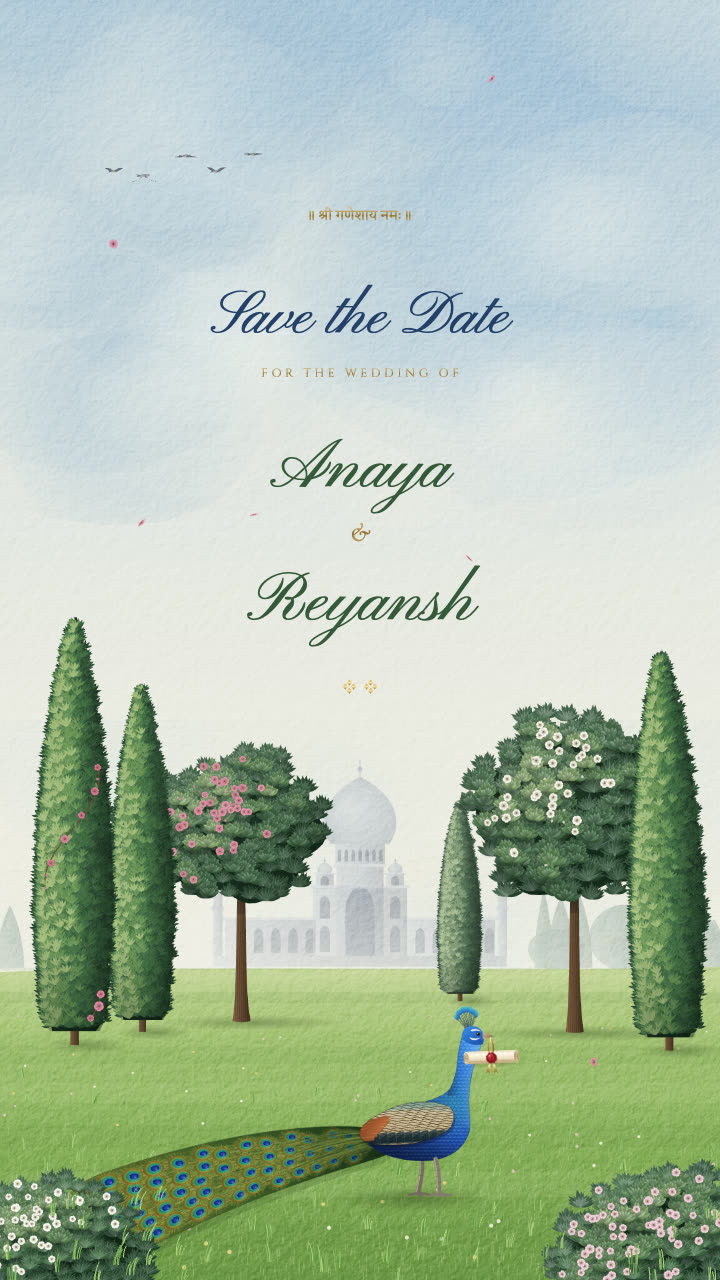 Seen hereBaghSave the Date invitation
Bagh is the kind of card that finds the right family by instinct. A peacock crosses a Mughal garden carrying a sealed invitation scroll in its beak, under a watercolour sky with cypresses, blossoming trees and a distant palace. The camera rises from the peacock to reveal the card. It is a save the date in two cards, and families who love it tend to know the moment they see it.
How to order
Once you have chosen, send us your names, dates and venue on WhatsApp. We will prepare a proof within 48 hours, with two rounds of changes included. A still invitation is ₹5,000 and an animated one, delivered as a video, is ₹10,000.
If nothing in the collection feels quite right, and you have an idea of your own, we can draw an entirely new design for ₹15,000. A proof and two rounds of changes are included, though we take only a few custom commissions each month.
Every card is 1080 by 1920, sized for WhatsApp and Instagram, and illustrated in our studio.
Next storyMinimalist Wedding Invitations for Modern Indian Couples
Explore the collection of luxury wedding invitations, or write to us on WhatsApp.