NRI Wedding Invitations: Inviting Family Across the World
How to send wedding invitations to family overseas: timing for time zones, bilingual cards, explaining traditions for Western guests, and digital vs physical.
When a family is scattered across Delhi, Dubai and Dallas, a wedding invitation has to travel further than the next neighbourhood. It has to land in inboxes at sensible hours, make sense to cousins who have never seen a phera, and carry the warmth of home to people who miss it.
This is the quiet work of an NRI wedding invitation. It does not just announce a date. It bridges time zones, languages and, sometimes, two very different ideas of what a wedding looks like. Here is how we think about it in the studio.
Why the overseas card needs extra care
A guest in the same city can ask questions over chai. A guest in London or Toronto cannot. They receive a card, they look at a date, and they must decide whether to book a flight, take leave and pack for a week of celebrations they may not fully understand.
The invitation is their only guide. If it is unclear, they will message the family at midnight (their time, not yours). If it is too brief, they will arrive unsure what to wear or what to expect. A well-made card answers the questions before they are asked, so the guest can simply say yes and start planning.
This matters especially for non-Indian partners, friends and colleagues who may be attending their first Indian wedding. For them, even the word "sangeet" needs a line of explanation.
Timing for time zones
A WhatsApp message sent at ten in the morning in Mumbai lands at half past four in the morning in New York. That is not a gentle way to invite someone to your wedding.
When your guest list spans continents, think about when people will actually see the card. A message sent in the Indian evening reaches Europe in the afternoon and the Americas in the morning. That is usually the kindest window.
If you are sending a batch of invitations, it helps to split the list. Send to India and the Gulf first, then wait a few hours before sending to Europe and the Americas. The card arrives when people are awake, and it feels more personal than a message that clearly went to everyone at once.
For the save the date, give overseas guests more notice than anyone else. Flights are expensive when booked late, and leave from a job abroad is harder to arrange. Our guide to save the date ideas for Indian weddings has more on timing.
Bilingual cards: Hindi and English together
Many families want both languages on the card. The elders read Hindi; the younger relatives abroad are more comfortable in English. A bilingual invitation honours both.
The question is how to arrange them. Some families put Hindi on the first card and English on the second. Others place both on the same card, with Hindi above and English below, or side by side. The right choice depends on how much text you have and how the design carries it.
 Seen hereBahaarWedding invitation
Bahaar is a painted palace garden with flowering trees, a gold chhatra and a carved sandstone chhatri. It comes as three cards: invitation, events and thank you. The calm centre of the design leaves room for text in two languages without crowding, and the garden motif is instantly Indian without being tied to one region.
A few practical notes for bilingual cards. Keep both versions saying the same thing; do not add extra blessings in one language that are missing from the other. Write the date in a format everyone understands: "14 February 2027" is clear in any language. And if you are including family names in Hindi, double-check the spellings with the elders before the card goes out.
Explaining traditions for Western guests
A guest who has never attended an Indian wedding may not know that a mehendi is not the same as a sangeet, or that the haldi involves turmeric paste and a fair amount of mess. A short, warm explanation on the events card makes a real difference.
You do not need a full essay. A line or two is enough: "Haldi: a blessing ceremony with turmeric paste. Wear clothes you do not mind getting yellow." Or: "Sangeet: an evening of music and dancing. Festive dress, comfortable shoes."
This is especially helpful for dress codes. "Indian formal" means nothing to someone who has never worn a lehenga or a kurta. Be specific: "Men: kurta or suit. Women: saree, lehenga or cocktail dress in bright colours." If you are arranging outfits for guests, say so, and they will arrive relieved instead of worried.
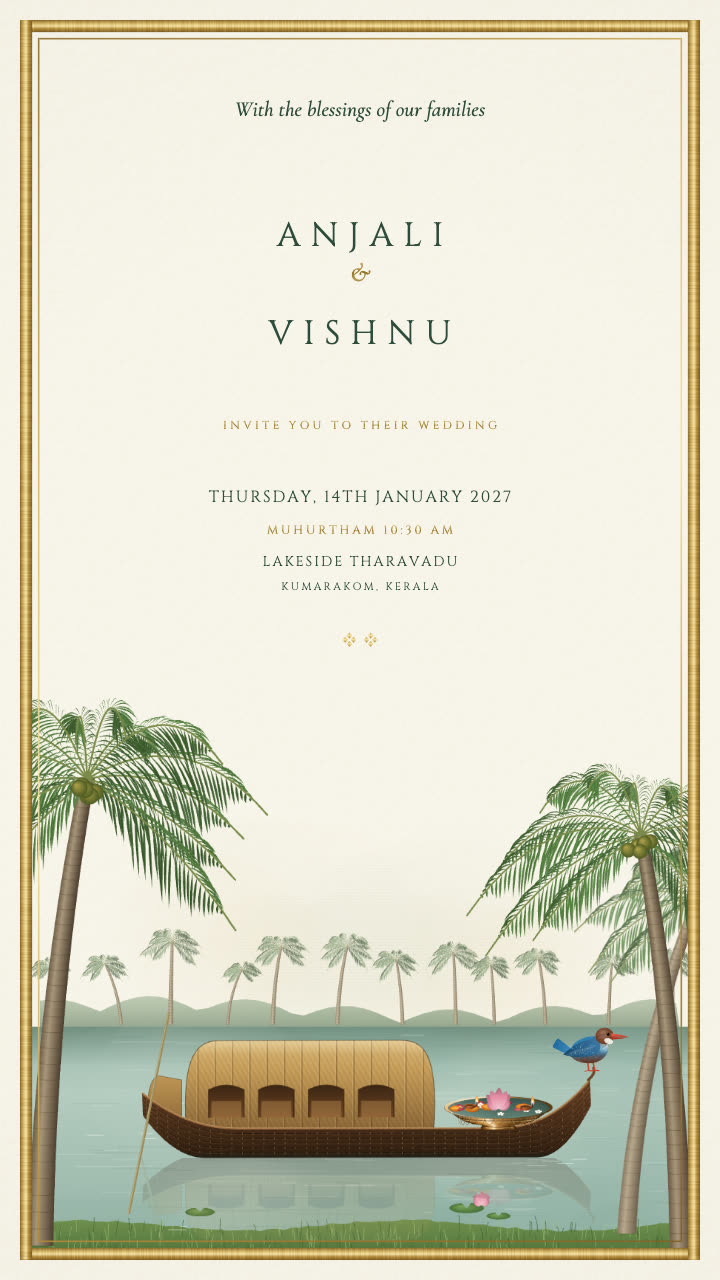 Seen hereKasavuWedding invitation · Malayali
Kasavu opens on a Kerala backwater, where a kettuvallam glides in carrying the wedding uruli of floating flowers and lamps. It is a beautiful choice for a Malayali family with relatives in the Gulf or the Americas, and the gentle animation gives overseas guests a glimpse of the world they are travelling to.
Digital invitations for overseas guests
A printed card posted to California takes two weeks and may arrive bent. A digital invitation arrives in seconds, plays on any phone, and can be saved, forwarded and watched again.
For NRI weddings, digital is almost always the better choice. The card reaches everyone at the same time, it looks exactly as you designed it, and guests can share it with their own families without asking for extra copies.
Every Taarikh card is 1080 by 1920 pixels, sized for WhatsApp and Instagram, so it fills a phone screen the same way in Chennai or Chicago. If you are sending to older relatives with slower connections, a still version of the same design opens instantly, and they miss nothing important.
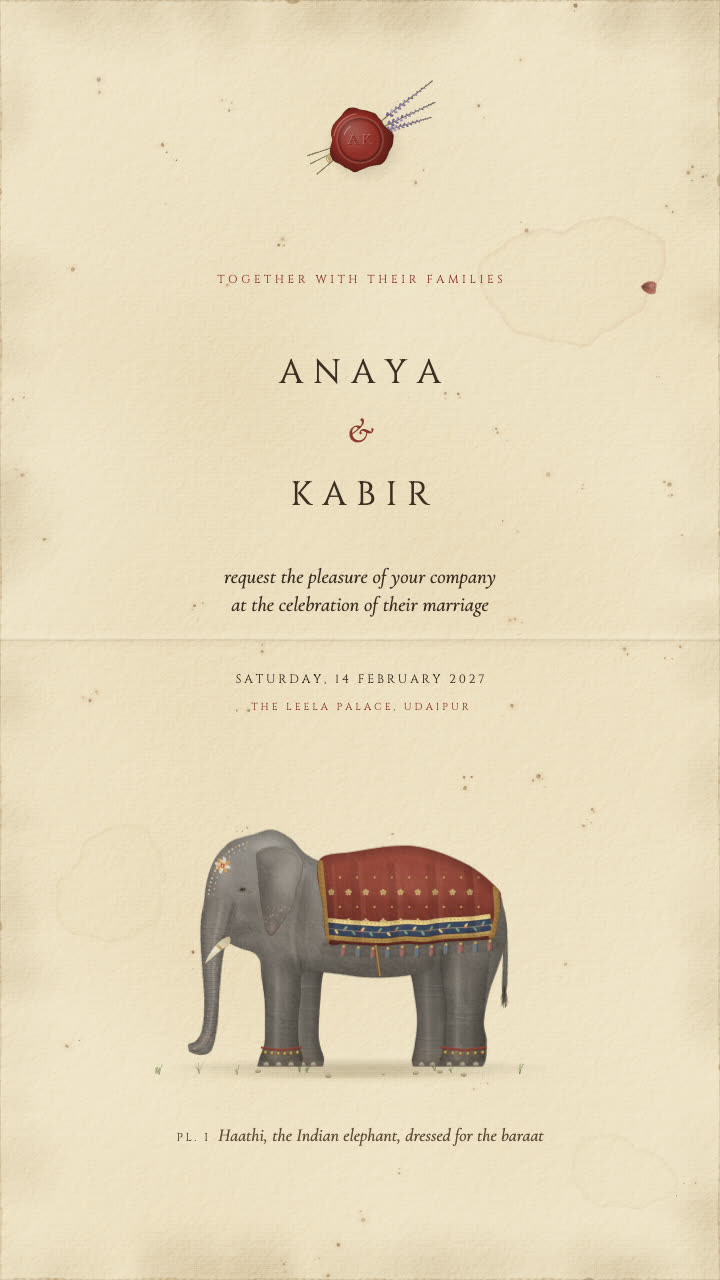 Seen hereHaathiWedding invitation
Haathi is an aged natural-history plate: one Indian elephant dressed for the baraat, painted in fine Company School brushwork under a red wax seal. It is timeless in a way that travels well. A cousin in London who has never been to a big Indian wedding will recognise the elephant, the marigolds, the mood.
Keeping track of who has seen the card
When guests are spread across the world, it is easy to lose track of who has received the invitation and who has not. A few simple habits help.
Make a list, country by country, before you send. Mark each name once the card is delivered. If WhatsApp shows a grey tick instead of a blue one, the message may not have arrived; follow up gently after a day or two.
For important relatives, a phone call after the card is a kindness. It tells them the card was personal, not a broadcast, and it gives them a chance to ask questions they might hesitate to type.
Connecting overseas guests before the wedding
A guest flying in from abroad may know the couple well but not the other guests. A short welcome note, sent a week before the wedding, can help.
Include the full schedule, the venues, what to wear each day, and a name and number for questions. If you are arranging transport from the airport or a WhatsApp group for the family, mention it. The goal is to make the guest feel expected, not just invited.
 Seen herePhulkariWedding invitation · Punjabi
Phulkari is a hand-stitched phulkari border with silk tassels, and a sarson field where the baraat dhol rests while two sparrows share a sprig of mustard flowers. For a Punjabi family with relatives in Canada or the UK, it carries a sense of home that photographs cannot.
Ordering your NRI wedding invitation
Choose a design from the collection and write to us on WhatsApp with your names, events, dates and venues. If you need bilingual text, send both versions and we will arrange them in the design. We personalise every card in our studio and send a proof within 48 hours, with two rounds of changes included.
A personalised still invitation is ₹5,000. The same design animated, delivered as a video, is ₹10,000. An entirely new design, drawn around your own idea, is ₹15,000. We accept only a few custom commissions each month.
Send the card at a kind hour, explain the traditions in a line, and your family across the world will arrive knowing what to expect and ready to celebrate.
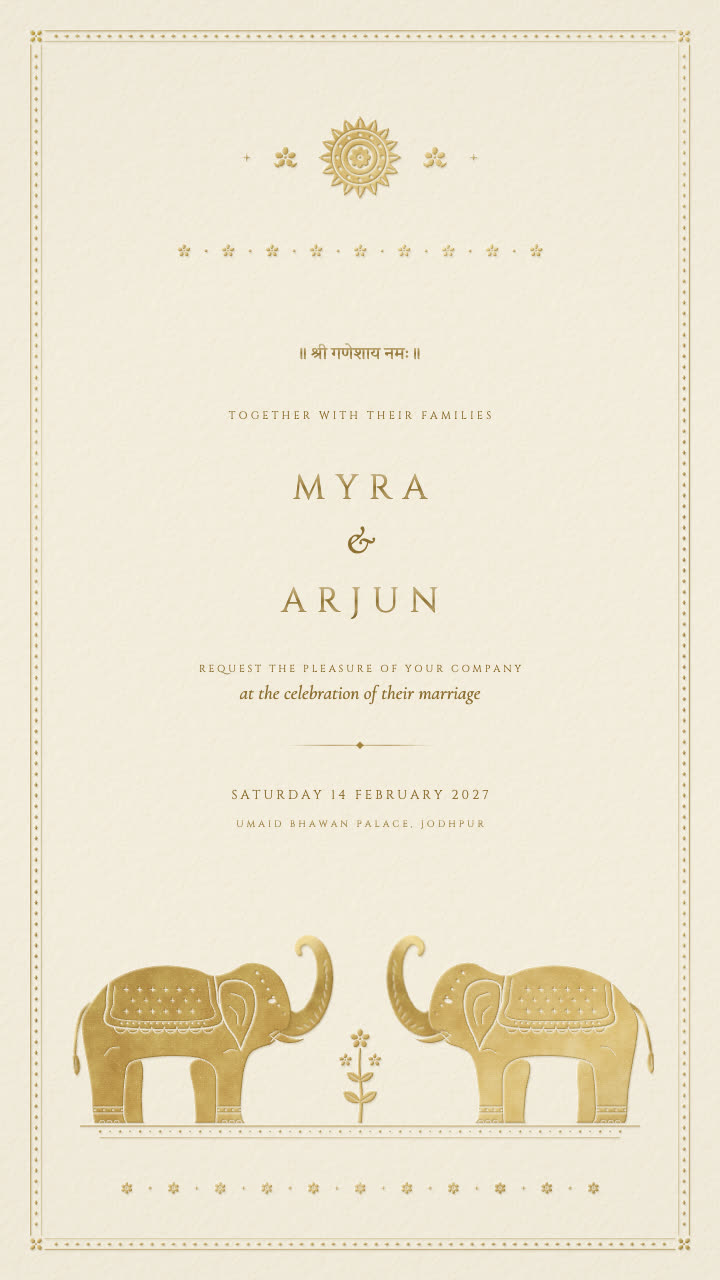 Next storyRoyal Palace Wedding Invitations: Designs for Grand Celebrations
Explore the collection of luxury wedding invitations, or write to us on WhatsApp.